An industry that punches below its weight
When the pandemic brought the world to a standstill in 2020, enterprises faced an almost impossible challenge overnight: keep thousands of employees connected, productive, and operational from their homes. It was the global community of telecom, mobility, and IT management professionals who made it possible, often within days, across organizations of every size and sector. The scale and speed of that response should have permanently changed how enterprises think about this discipline.
Nevertheless, the TEM industry, and its evolving extensions into mobility, cloud, and SaaS, remains undervalued and stuck with the same problems. While CRM, ITSM, and BSM platforms have grown into multi-billion-dollar markets, only a handful of TEM vendors have ever crossed the hundred-million-dollar revenue threshold.
The underlying challenges haven’t changed in twenty years.
Problems have been tackled the wrong way. Over the last two decades, various changes have been applied to the TEM industry: features have been added, the category has been rebranded under a broader scope (Network Expense Management, Cloud Expense Management) and different pricing models have been implemented. But none of this has made the industry grow considerably.
The problem is that these solutions are mainly superficial and mask the same underlying issues.
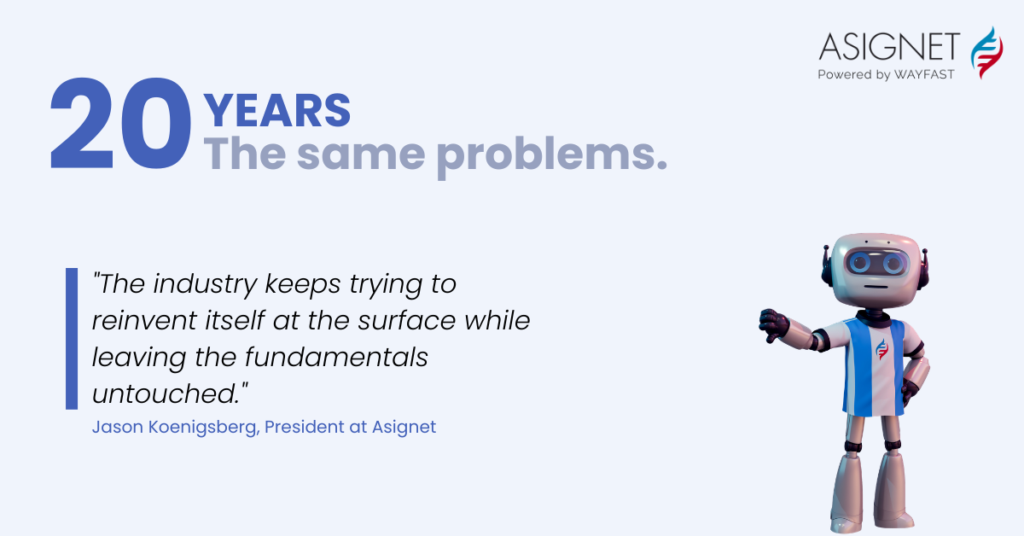
“The industry keeps trying to reinvent itself at the surface while leaving the fundamentals untouched. A new name for the same problem is still the same problem.”
Rebranding does not fix misaligned incentives. Adding a new product line does not fix broken buyer-seller dynamics. And no amount of feature development closes the gap between what TEM programs deliver and what enterprise leadership actually cares about.
Because of this, customer churn remains high and satisfaction remains inconsistent, keeping the market small.
Who cares about what we do?
In most organizations, company leadership does not care about what the TEM industry does. They simply see a number that keeps increasing year after year, without really understanding the value of these services.
Why is this? Because most vendors approach clients with the same pitch: “we will reduce your costs and maximize your savings”, without realizing that leadership’s main concerns lie elsewhere.
Take Salesforce or ServiceNow. Both platforms have grown enormously over the past few years, largely because of how they pitch their clients. They understand what leaders actually care about and they address that directly. “Invest with us and we will transform your business”, not “we will cut your costs.” Their message centers on business impact, competitive advantage, and strategic capability.
Before any relationship begins, TEM vendors should be asking: “What does your executive team care about most right now?”
Short-term relationships — what nobody wants
Roughly two-thirds of enterprises are dissatisfied with their current TEM provider. Around a third are actively considering a switch. The remaining third feel trapped, since changing providers is more painful than staying with an underperforming one.
This is largely the result of an industry that has built its entire value proposition around saving money. Once costs have been reduced, there is nowhere for the relationship to go. That narrative gives TEM vendors a ceiling, a limited, transactional relationship defined entirely by savings.
The inventory problem nobody talks about
Every company has an inventory, but almost none of them are accurate. A complete, reliable inventory is the foundation of everything else: contract negotiations, budgeting, forecasting, spend analysis, reporting, and strategic planning all depend on knowing, with confidence, what the organization has and what it is paying for.
The opportunity
The opportunity is real, the technology is finally ready, and the demand for visibility and control over enterprise IT spend has never been higher.
One capability the TEM industry must prioritize is automation. Hyperautomation is not a trend, it is the only realistic approach to managing the scale and complexity of modern enterprise IT spend. The vendors that invest in it seriously will be the ones that grow.
How Asignet incorporates automation
At Asignet, we have embraced 100% hyperautomation — not as a marketing position, but as a conviction about what it actually takes to handle the scale and complexity of today’s enterprise IT environments. Spreadsheets cannot do it. Semi-automated tools cannot do it. And neither can platforms that automate isolated tasks while leaving the rest of the lifecycle manual.
We also believe TEM deserves to sit at the same table as ERP, CRM, and ITSM. That means deeper integrations, stronger governance, better user experiences, and a value story that speaks directly to CIOs, CFOs, and procurement leaders — not as a back-office expense service, but as a strategic layer of enterprise infrastructure.
The change has to start somewhere. It starts with one vendor and one client deciding to do things differently. Then two. Then ten. That is how the industry finally steps off the wheel and starts moving forward.
— Jason Koenigsberg, President, Asignet