The problem with savings as a strategy
For more than thirty years, the TEM industry has approached clients with the same pitch: we will reduce your telecom and IT costs. It is an attractive proposition: it is clear, tangible, and every business is interested in saving money. But the problem is that you cannot build an entire industry on cost reduction alone, especially when savings are not infinite.
Consider this scenario: a TEM team announces they found $5 million in savings. The TEM team celebrates, IT leadership wonders whether those savings signal good management or chronic mismanagement, and finance tries to reduce next year’s budget by that amount, only to be surprised when overall spending increases the following year anyway.
“Savings that confuse every stakeholder above the TEM team are not a value proposition. They are a communication problem dressed up as a win.”
The paradox that punishes good work
The savings model has created a problem that has quietly damaged the TEM industry for years: the better a TEM vendor does its job, the more likely they are to lose it.
Why? Imagine a TEM provider spends two to three years helping a business organize and clean up its environment, fixing billing errors, tightening contracts, improving visibility over invoices and subscriptions. By year three, the volume of savings naturally declines because the environment is genuinely healthier and better managed. The client, who measures TEM performance purely by savings because that is the only metric they have ever been given, concludes that the provider is no longer doing its job and decides to switch.
The provider who delivered real results gets fired. The provider who keeps an environment just messy enough to generate large savings numbers every year stays.
Who actually cares about savings and who doesn’t
Savings matter most to the people closest to the billing — the TEM team itself, and sometimes the IT team. The further up the organization you go, the less relevant the savings number becomes, and the more problems it can actually create.
The question every TEM professional and every vendor should be asking is not “how much did we save?” but “what does each stakeholder group actually care about?” The answer changes significantly depending on who is in the room.
TEM Team: beyond savings, what matters most? Inventory accuracy, invoice processing reliability, contract compliance, efficient workflows, accurate reporting.
IT Leadership: what keeps them up at night? Security posture, operational efficiency, risk mitigation, enabling business initiatives, supporting digital transformation.
Executive Leadership: what do they actually measure success by? Revenue growth, competitive positioning, customer experience, risk reduction, innovation capability, market perception.
TEM can contribute to every one of these objectives — but it almost never does, because the conversation never gets there. The industry defaults to savings before asking what stakeholders actually need, and then wonders why it cannot break through to the executive level.
What to measure instead
The shift from savings to outcomes is not about abandoning financial discipline. It is about adding the measures that actually tell you whether a TEM program is improving the environment, supporting the business, and delivering sustainable value over time.
|
Metric
|
What it actually tells you |
Stakeholder audience |
|
Inventory accuracy % |
Whether the organization truly knows what it has and what it pays for — the foundation of everything else |
TEM, IT, Finance |
|
Invoice processing time |
Operational efficiency of the billing cycle — and a proxy for how much manual work the team is still doing |
Finance, Operations |
|
Contract catalog completion % |
Whether contracted terms are actually being tracked and enforced |
Legal, Procurement, Finance |
|
Order-to-implementation time |
How quickly the organization can turn technology decisions into operational reality |
IT Leadership, Operations |
|
Error recurrence rate |
Whether root causes are being fixed, or just the same symptoms treated over and over |
TEM, IT, Vendors |
|
Internal user satisfaction |
How the people who depend on the infrastructure experience it day to day |
All stakeholders |
|
Contributions to IT/business objectives |
Whether TEM is actively advancing the goals that executive leadership actually cares about |
IT Leadership, Executives |
These metrics provide a much broader picture of how a TEM vendor can genuinely help an organization. One that goes well beyond savings and actually reflects the true value of an effective provider.
The operating model that makes it sustainable: the Center of Excellence
Better metrics and a broader value conversation are necessary, but they are not sufficient on their own. Organizations that make the shift from cost-center TEM to strategic TEM need an operating model that supports it. That model is the Center of Excellence.
A CoE is a deliberate structure built around shared best practices, clear ownership, and a direct link between the management environment and the business results that leadership cares about. It is what happens when TEM stops being something that happens to a company and starts being something the company actively builds and invests in.
How Asignet powers the shift
Operational RPA built for IT expense management Asignet pioneered the first Operational RPA in the industry — not automation of isolated tasks, but end-to-end lifecycle automation from invoice ingestion to validation, dispute management, and reporting. This is what frees TEM teams to stop fighting fires and start operating strategically.
Low-Code platform that adapts to your practice Because Asignet runs on Low Code, organizations can shape workflows around their own processes — not the other way around. That flexibility accelerates adoption, reduces friction during change, and produces a platform that evolves with the business rather than constraining it.
Global capability at enterprise scale For multinational organizations, fragmented data is the enemy of a coherent CoE. Asignet processes invoices across languages, currencies, and regions — giving global teams a single, reliable view of their entire IT expense management practice.
What the shift from cost center to strategic contributor actually looks like
-
Conversations with leadership move from “how much did we save on invoices” to “how did we support the company’s strategic priorities this quarter.”
-
Reporting is designed for the audience that receives it — not a uniform output that nobody reads closely.
-
Problems get surfaced early, when they are still manageable, rather than escalated after they have already caused damage.
-
Vendor relationships are managed as partnerships with shared accountability for outcomes on both sides.
-
The TEM function becomes visibly indispensable to leadership — and earns the investment and organizational standing that comes with it.
Asignet
When we think about how to measure TEM program performance, savings is part of the picture — but it is not the frame. The metrics that tell the most meaningful story about a program’s health are operational and process-oriented: Order to Implementation Time, Invoice Inventory Accuracy, Contract Catalog Completion, and Internal User Satisfaction. These are the numbers that reflect whether an environment is genuinely improving, not just whether errors are being caught and corrected.
At Asignet, we measure our own success by these standards. And we believe organizations that adopt this framing — and build their stakeholder reporting around it — are the ones that will finally earn the executive visibility and strategic standing that TEM programs have historically struggled to achieve.
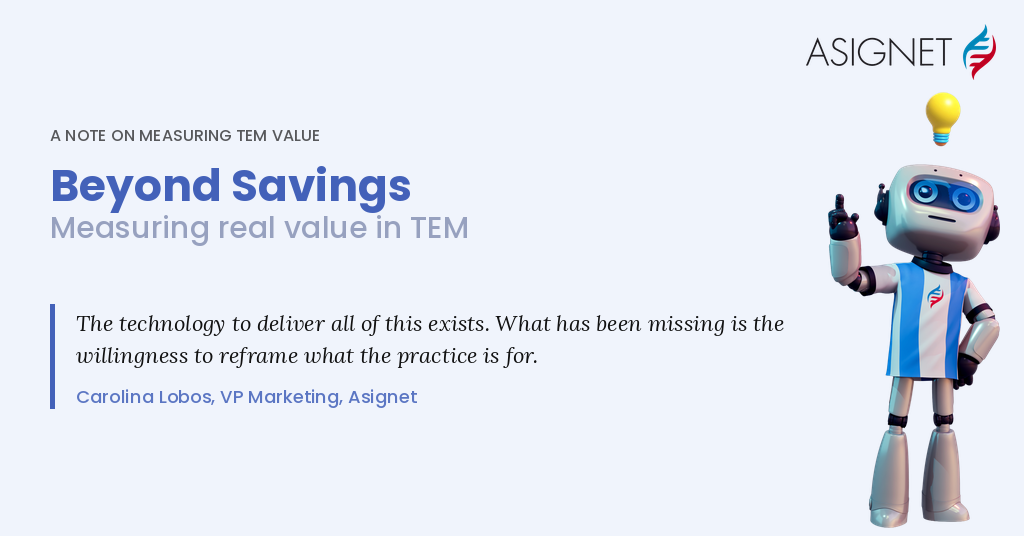
The technology to deliver all of this exists. Hyperautomation, AI-assisted processing, low-code workflow adaptation, global invoice handling — none of this is theoretical anymore. What has been missing is the willingness to reframe what the practice is for. That is the shift we are committed to driving.
— Carolina Lobos, VP Marketing, Asignet
Conclusion
From the very beginning, the TEM industry has positioned itself as a savings service: one whose primary purpose was cutting unnecessary costs and identifying billing discrepancies. That framing has kept the industry small and prevented it from growing to its true potential. Savings alone will not drive the industry forward.
TEM leaders need to adopt a new set of metrics, ones that actually matter to leadership. A different conversation with stakeholders, one that starts with what they care about rather than what the TEM team found in the invoice queue. And an operating model, the Center of Excellence, that gives the practice the structure, accountability, and technology it needs to deliver consistently at scale.