How to Fix the TEM Buyer-Seller Relationship
There are two main issues that make TEM relationships difficult, and both stem from the same fundamental failure: neither side invests enough time in honest communication before anything is signed or built.
The first breakpoint is the process itself. How buyers evaluate vendors, how vendors pitch buyers, and how procurement fits into all of it creates friction, mistrust, and wasted effort before the relationship even begins. The second breakpoint is the ongoing relationship — how both sides behave once the contract is in place, what happens when things go wrong, and why so many TEM engagements end in blame rather than growth.
Fixing both requires a different approach from day one.
“The process that brings a buyer and vendor together sets the tone for everything that follows. If it starts with misrepresentation on one side and fishing expeditions on the other, the relationship is already in trouble.”
What the current process actually looks like
In almost every TEM evaluation today, the wrong people are running the process — and as a result, the focus ends up on the wrong things too. Procurement typically leads the evaluation instead of the business team that best understands what the company actually needs.
TEM is not a commodity purchase. Competing solutions may look similar on paper, but what differentiates a program that works from one that fails is almost always the quality of the working relationship between the people involved. That relationship cannot be evaluated through an RFP managed entirely by people who will not be working in the program day to day.
Procurement’s genuine value lies in the final stages of a decision: contract terms, pricing frameworks, risk management, and compliance requirements — not in sorting feature lists or acting as the primary filter between two teams that need to understand each other’s environments to succeed together.
On the vendor side, the problem is equally predictable. Pitches tend to lead with “we are the only ones doing this,” followed by a list of promises that are unlikely to be fully delivered. The result is underdelivering after signing. Demos are rarely designed around the client’s specific situation — they are standardized for every sales process, regardless of who is in the room.
Knowing the battlefield: why context is everything in TEM relationships
Successful long-term TEM relationships share one characteristic that struggling ones almost universally lack: both sides put their real constraints, limitations, and anticipated failure points on the table before the contract is signed.
For buyers, this means being specific about internal challenges — teams that resist change, contracts that may be hard to locate, IT leadership that is not fully aligned behind the initiative, and what actually went wrong with previous providers. For vendors, it means being honest about where the platform is strong and where it has gaps, and what the client will need to invest internally for the engagement to work. The most important conversations in any TEM relationship happen before anything is signed.
What an ideal evaluation process looks like
The buyer provides a concise document covering the current environment, the top five challenges, desired outcomes, services needed, and a transparent statement of where the organization actually stands in its decision process.
Vendors respond directly to what the buyer described — how they address each challenge, how they contribute to IT and leadership objectives, and what they can and cannot support. No pricing at this stage.
Two working sessions follow: the first to review each area, ask real questions, and build shared understanding; the second to show the vendor’s actual capabilities through a demo scoped specifically to the client’s environment and needs — not a generic walkthrough.
Only in the third session does pricing and implementation come to the table. At that point, pricing, SLAs, dependencies, variables, and a realistic implementation plan are reviewed together by both sides.
Finally, procurement enters the process for what it does best: contract terms, risk, compliance, and final pricing.
Asignet’s approach
At Asignet, we believe the sales process should be the first chapter of a partnership, not a competitive transaction to be won. Both sides need to enter it with the right mindset — and real expectations have to be set from day one. Vendors who listen closely to what clients actually need, rather than defaulting to a standard pitch, are the ones who build relationships that last.
Our approach is to refuse to conform to industry norms that do not serve clients well. One concrete example is our Proof-of-Concept process, which has been redesigned and shortened to give prospective clients a genuinely honest picture of what the working relationship will look like — and what results they can realistically expect. We invest in having the right professionals at every stage of the client lifecycle because the relationship does not end when the contract is signed.
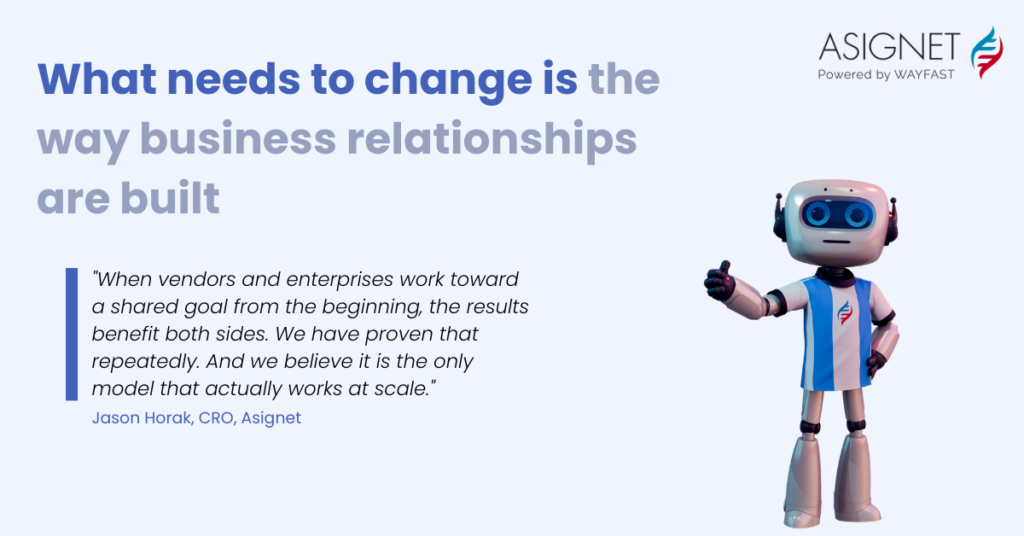
When vendors and enterprises work toward a shared goal from the beginning, the results benefit both sides. We have proven that repeatedly. And we believe it is the only model that actually works at scale.
— Jason Horak, CRO, Asignet
Conclusion
The TEM buyer-seller relationship has been failing at the same points, for the same reasons, for a long time. Fishing expedition RFPs that waste vendor resources. Procurement walls that prevent the relationship-building that determines success. Overpromising that destroys trust before delivery even begins. And a persistent unwillingness, on both sides, to have the honest conversations that would prevent most relationship breakdowns.
What needs to change is the way business relationships are built — how vendors and buyers engage with each other: with full transparency about where they stand, what their capabilities are, what their limitations are, and what they need. That is the foundation of every lasting relationship.