Businesses and IT professionals need cloud management strategies to make sure their cloud usage is efficient and productive. Without them, businesses face a range of problems, including higher costs, poor performance, security gaps and data loss.
The need is growing. Gartner forecast worldwide public cloud spending to reach $723 billion in 2025 and predicts that 90% of organizations will adopt a hybrid cloud approach through 2027, which means more providers, more accounts and more to manage.
What Is a Cloud Management Strategy?
A cloud management strategy is a plan for controlling an organization’s public, private or hybrid cloud resources and services. Its goal is to maximize the benefits of the cloud while minimizing its costs and risks.
The cloud offers scalability, flexibility and on-demand access to data and applications. But without proper management, those same qualities can lead to poor performance, security gaps and costs that grow every month.
Why Is Cloud Management Important?
The cloud lets companies store data and run applications centrally and access them from anywhere, at any time. But businesses don’t always understand how best to manage their cloud resources, or how those resources affect the rest of their operations.
Good cloud management keeps performance consistent for every user and device. A poorly performing cloud setup slows employees down across teams and departments. And without centralized control over who can access sensitive data, the risk of a security breach rises.
A Common Misconception About the Cloud
Many companies treat public cloud services like a utility: they use it every month and pay the bill at the end. Many then find they’re spending more than they did on-premises. Cloud providers won’t point out more efficient ways to use their services. You have to manage the cloud as carefully as you manage on-premises infrastructure.
6 Cloud Management Strategies
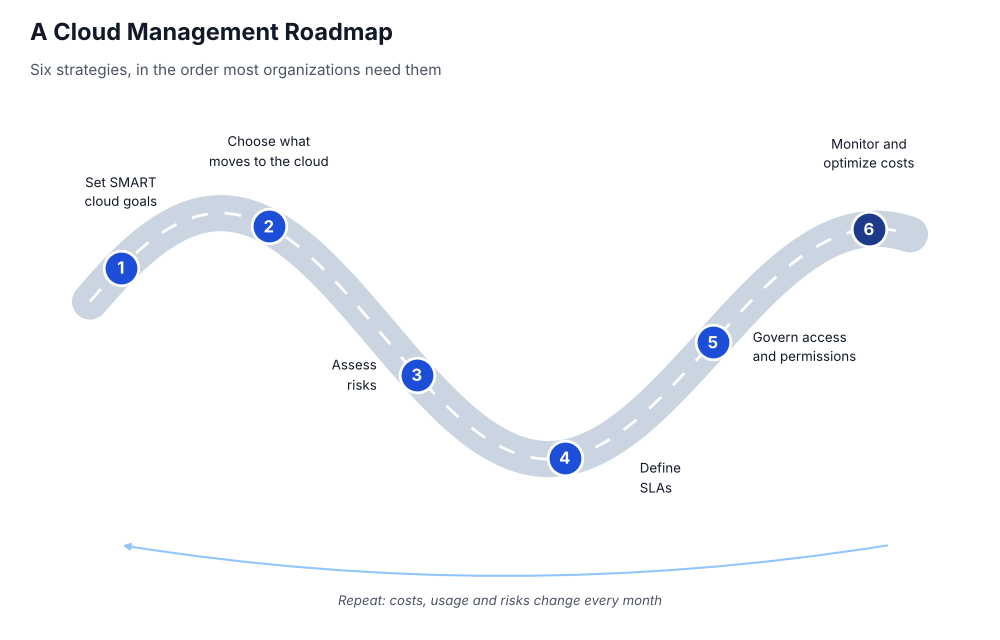
1. Set Clear Cloud Goals
Start by defining exactly what your company wants to achieve with the cloud, and how cloud opportunities connect to your strategic business objectives and technology direction. The most effective goals meet the SMART criteria: specific, measurable, agreed upon, realistic and time-bound. Define the activities, roles and responsibilities needed to reach them.
2. Choose What Moves to the Cloud
The cloud isn’t a one-size-fits-all solution. Not every application or data set needs to move. Decide which business functions belong in the cloud, then build a plan for migrating those applications and data.
Implementation involves many steps, from inventorying applications and their data volumes to designing the target architecture, including virtual servers and desktops, networking, security and storage. It takes expertise to design and configure all of these elements with minimal downtime for users.
3. Conduct a Cloud Risk Assessment
A cloud risk assessment helps you identify the business and technical risks of using the cloud, and how to mitigate them. It should also assess your IT architecture’s technical maturity and identify anything that needs to be improved or reworked before or during migration.
Have a plan for responding to incidents in the cloud, too. A response plan minimizes the impact of an incident and keeps the business running.
4. Create Service Level Agreements (SLAs)
SLAs define what both the business and IT can expect from the cloud, such as availability, performance, support response times and data protection. Review your cloud providers’ SLAs as well, so you know what they guarantee and what remains your responsibility. Clear SLAs prevent misunderstandings and surprises down the road.
5. Govern Access and Permissions
Manage user permissions and access controls centrally, so users get only the access they need and sensitive information doesn’t end up in the wrong hands. As more organizations use multiple clouds, a single interface for managing access across private, public and hybrid environments becomes increasingly valuable.
6. Monitor and Optimize Continuously
Implement monitoring and logging to track performance, security events and spending. A cloud management platform gives you one point of control across multiple cloud providers and services, so you can spot waste, catch problems early and optimize continuously. For specific ways to reduce spending, see our guide to optimizing cloud computing costs.
Make Cloud Management an Ongoing Practice
The cloud presents new opportunities and challenges for businesses. With careful planning and execution, your organization can take full advantage of it. The most important thing is to tailor these strategies to your organization’s specific needs, and to revisit them regularly, because your costs, usage and risks will keep changing.
Asignet’s Cloud Expense Management solution brings your cloud bills, usage and accounts together in one place, so you can see and control your spending across providers. Learn more about Cloud Expense Management or talk to Asignet.