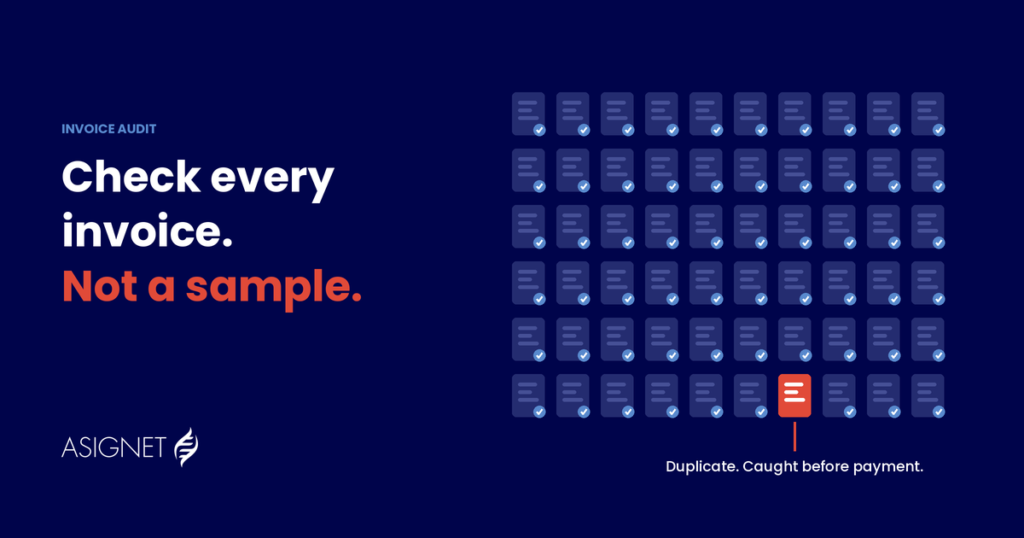
Most invoices are right. That's exactly the problem. When nearly every invoice is fine, it's easy to stop looking, and the few that aren't (a duplicate, a rate that crept up, a service that should have stopped) get paid along with the rest.
An invoice audit is how you find them. This article explains what an invoice audit is, the two ways to run one, a step-by-step process, and what to check on every invoice.
What is an invoice audit?
An invoice audit is a review of supplier invoices to confirm that each one is accurate, legitimate and billed according to what was ordered, received and agreed. It checks the vendor, the amounts, the quantities, the prices, the taxes and the math, and flags anything that doesn't match.
Invoice auditing protects you from three things: paying errors, paying twice and paying someone who shouldn't be paid at all.
Pre-payment vs. post-payment invoice audits
There are two moments to audit an invoice, and they work best together.
| Pre-payment audit | Post-payment audit | |
|---|---|---|
| When | Before the invoice is approved | After it's been paid, usually months later |
| Goal | Stop errors before money leaves | Find and recover what slipped through |
| Coverage | Ideally every invoice | Often a sample or a period |
| Result | Corrected or rejected invoices | Credits and refunds from vendors |
A pre-payment audit is cheaper: it's always easier to not pay than to get money back. A post-payment audit is the safety net, and it shows where your pre-payment checks have gaps.
How to do an invoice audit in 6 steps
1. Decide what to audit
Start with the vendors and categories where errors are most likely: high volume, complex bills, usage-based pricing or frequent price changes. Telecom, cloud, SaaS, logistics and facilities are common starting points. Choose the period, and decide whether you'll check every invoice or a sample.
2. Gather the documents
For each invoice, collect what it should match: the purchase order, the goods receipt or delivery note, the contract or rate card, and, for services, usage data or the inventory of what's active. Many invoices only exist in supplier portals; robots can log in and pull them for you.
3. Check the basics
Before comparing anything, confirm the invoice is real and complete: a known vendor, correct bank details, a valid invoice number, the right legal entity, correct tax and math that adds up. Most fraud and many duplicates are caught here.
4. Match it line by line
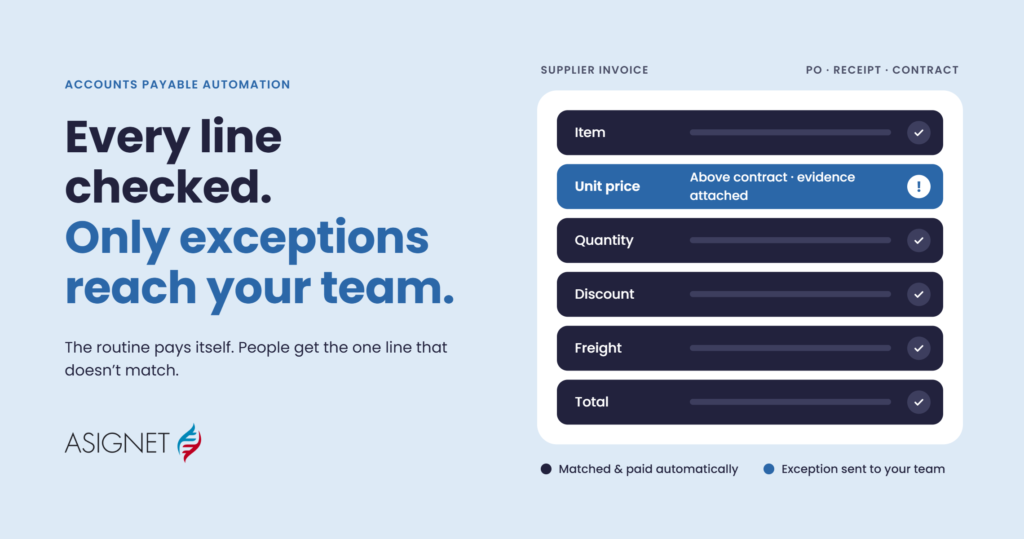
Compare each invoice line with the PO, the receipt and the contract. Two-way matching (invoice against PO) catches price errors. Three-way matching (invoice, PO and receipt) also catches paying for things you never received. For services without a PO, the contract and your inventory play the same role. Asignet's Invoice Validation does this for every line of every invoice.
5. Investigate the exceptions
Not every difference is an error. A price change may be in a new amendment; a quantity may have been delivered in two shipments. Send each exception to the person who can explain it, with the evidence, and decide: approve, correct or dispute.
6. Dispute, recover and fix
For real errors, ask the vendor for a corrected invoice or a credit note, and track it until it arrives. Then fix the cause, whether that's a wrong rate in the vendor's system, a missing check on your side or a contract nobody updated. Asignet's team handles disputes with vendors until the credit comes back.
What to check: an invoice audit checklist
| Check | What you're looking for |
|---|---|
| Duplicates | The same invoice sent twice, sometimes with a slightly different number or date |
| Vendor and bank details | A real, approved vendor, and no unverified change to their bank account |
| Math | Line totals, subtotals and taxes that add up |
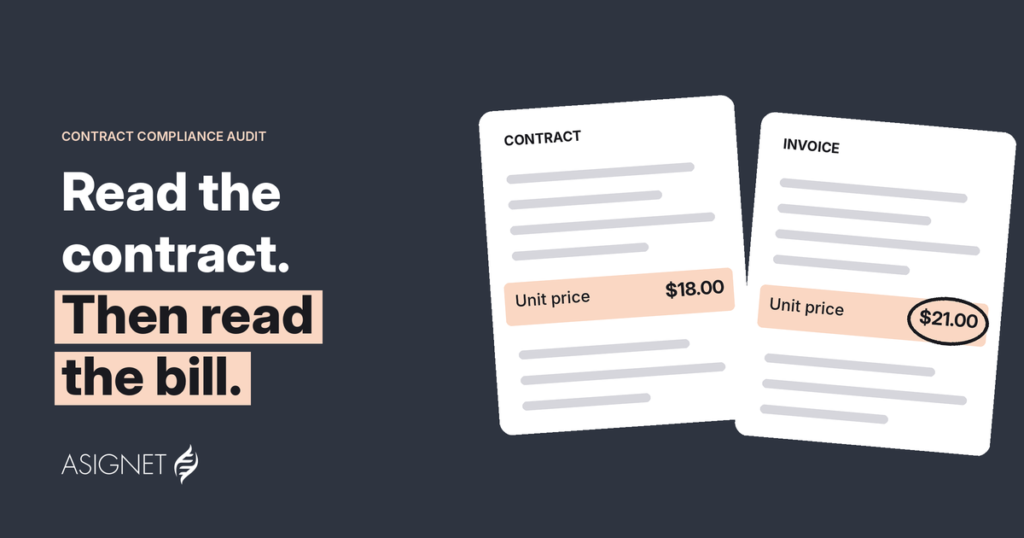
| Prices | Unit prices that match the PO or the contract |
| Quantities | Billed quantities that match what was received or used |
| Discounts and credits | Agreed discounts applied, promised credits included |
| Taxes | Right rate, right location, right items |
| Fees | Only fees the contract allows |
| Active services | Nothing billed for services, lines or licenses that were cancelled |
Sampling vs. auditing every invoice
Many teams audit a sample because checking everything by hand isn't possible. The trouble is that the costliest errors rarely show up in a sample: a wrong rate on one line, repeated every month, or a single duplicate among thousands of invoices.
Automation changes the math. When software reads each invoice and checks every line against the rules, auditing all of them costs about the same as auditing a few, and people only look at the exceptions.
That's how Asignet works: we use AI to build a reader for each new invoice layout, then read every invoice with WAYFAST AI, our own technology, and check each line against the PO, the receipt, the contract and your inventory.
Invoice auditing best practices
- Audit before you pay, not only after. Prevention is cheaper than recovery.
- Check every line, not just the total. An invoice can match the PO total and still be wrong.
- Verify bank detail changes through a separate channel, every time.
- Keep contracts where the audit can read them, with prices and terms as data, not buried in PDFs.
- Track exceptions by vendor. Repeat offenders deserve a conversation.
- Close the loop. A finding only counts when the credit arrives.
Where invoice audits find the most
Bills that are long, change every month or depend on usage are where errors hide best:
- Telecom: lines that should be cancelled, wrong plans, rates above contract. See telecom expense management.
- Cloud: missing discounts, idle resources, charges that don't match usage. See cloud expense management.
- SaaS: licenses billed for people who left, duplicate subscriptions. See SaaS management.
- Other vendors: rates, fees and services across the rest of your suppliers. See Business Spend Management.
Audit every invoice, not a sample
Asignet checks every line of every invoice against the PO, the receipt and the contract, and recovers the differences for you. See Invoice Validation and how disputes work.
Frequently asked questions
What is an invoice audit?
An invoice audit is a review of supplier invoices to confirm they're accurate, legitimate and billed according to what was ordered, received and agreed, before or after payment.
How do you audit invoices?
Decide what to audit, gather the PO, receipt and contract for each invoice, check the basics, match each line, investigate the exceptions, and dispute and recover the errors.
What is the difference between invoice auditing and invoice processing?
Invoice processing is the full flow of receiving, approving and paying invoices. Invoice auditing is the checking step inside it, which confirms each invoice is correct before it's paid, or finds errors after.
How often should invoices be audited?
Ideally every invoice, before payment, through automated checks. A post-payment audit once or twice a year helps find what the checks missed.
What are the most common invoice errors?
Duplicate invoices, prices above contract, wrong quantities, missing discounts, incorrect taxes, unapproved fees and charges for services that were already cancelled.