Most companies ask the wrong question when evaluating a TEM partner
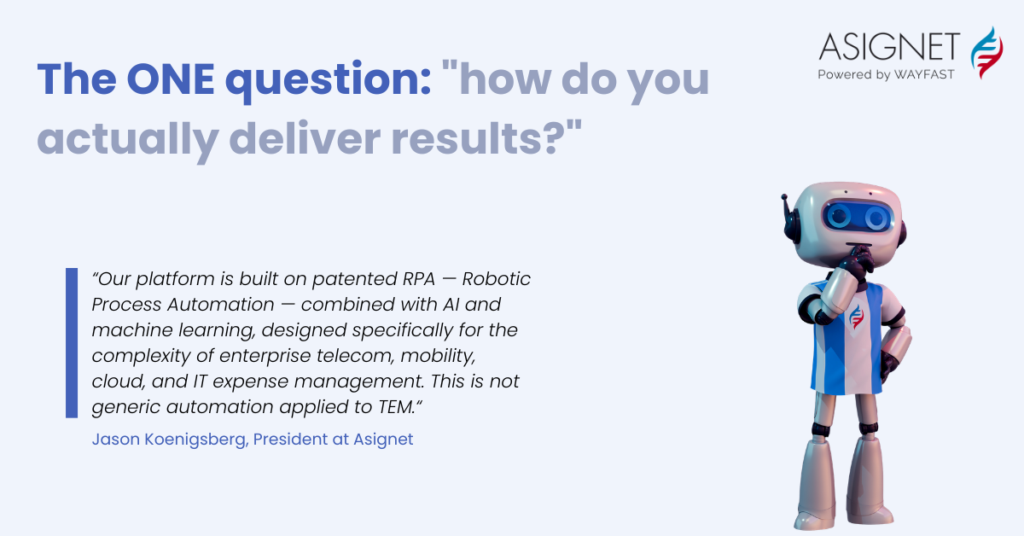
When an organization evaluates a new TEM provider, it usually asks questions like “what services do you offer?”, “what savings can you generate?”, and “what does your platform look like?” But the most important question they should be asking is “how do you actually deliver results?”
This may seem irrelevant as long as results are achieved, but the reality is that the answer to this question changes the whole outcome. The reason comes down to what is happening behind the interface: whether the processes are genuinely automated, partially automated, or dressed up to look automated while being largely manual underneath.
That difference determines the accuracy of your data, the reliability of your invoices, the speed of your operations, and ultimately whether your TEM program delivers real business value or just a recurring report.
Why invoice processing is harder than it looks
Invoice processing is the core of any TEM program — and it is far more complex than most people realize. Large organizations deal with several vendors, invoices in different languages, a large number of line items per invoice, and different contractual terms for each. Processing those invoices requires taking care of many things simultaneously: validating accuracy across thousands of line items, allocating costs across business units, securing payment approvals, reconciling payment records, and resolving the exceptions that inevitably arise at every step.
The questions an effective audit and optimization process has to answer are deceptively straightforward: Are credits and discounts properly applied? Are disconnected services still appearing on invoices? Are payments being applied to the right accounts? Are service plans aligned with actual consumption? Are assets and licenses still in active use? Each of these questions, applied across thousands of line items, represents an enormous operational burden — one that simply cannot be executed accurately and completely by human effort alone.
Manumation — the detail that makes a big difference
Many TEM providers claim to offer automated invoice processing but actually deliver something quite different: manumated processes. This is a combination of manual work and automation that looks like the real thing on the surface but relies heavily on human execution underneath.
Manumation typically looks like this: an automated tool handles the visible, straightforward parts of the process — the ones that are easy to demo — while the complex exceptions, edge cases, and multi-step validations are quietly handled by people behind the scenes. The client sees dashboards and reports. What they do not see is the team working to reconcile what the system missed.
The problem with manumation is not just that it is slower and more prone to errors than real automation. It is that it fundamentally limits what the partnership can deliver. When a significant portion of the processing depends on human execution, capacity becomes a constraint, errors become inevitable at scale, and financial opportunities get missed consistently — because the process was never designed to handle the volume.
Manumation
-
Manual and automation hybrid presented as fully automated
-
Exception handling done by people, not systems
-
Capacity constrained by team size and availability
-
Financial opportunities consistently missed at scale
-
Error rates increase as volume grows
-
Results dependent on individual performance
Real automation
-
End-to-end lifecycle automation with no manual gaps
-
Exceptions flagged and routed automatically
-
Capacity scales with the business, not the headcount
-
Financial opportunities identified in real time
-
Accuracy improves as volume and data grow
-
Results consistent and auditable at every step
Differentiation between these two models might seem small from the outside. It is not. The reason it matters is straightforward: people cannot effectively execute on all the invoice processing decisions required each month without making mistakes, and manumation consistently misses the financial opportunities that real automation would catch.
What automation actually unlocks — three types of efficiency
Operational Efficiency
Cost optimization — Repeatable processes run automatically, freeing people to make higher-value decisions rather than execute routine tasks.
Fulfillment acceleration — Manual friction and delays in the request-to-delivery workflow are eliminated, accelerating service delivery to internal teams.
Financial Efficiency
Budgeting reliability — Accurate, real-time financial data on assets, services, and licenses makes forecasting and budgeting far more dependable.
Waste elimination — Improved audit and optimization outcomes reduce the financial waste that accumulates when errors go undetected at scale.
Technical Efficiency
Digital transformation — Accurate, current data on assets, services, and their actual usage accelerates technology transformation initiatives across the organization.
Integration and visibility — A clearer understanding of the technology ecosystem enables more informed, top-down technology decisions across the business.
Asignet in practice — what the numbers look like
The value of genuine automation is most visible in the results it produces for real organizations. Here is what Asignet’s platform delivered for one multinational enterprise in 2022.
The environment
-
350+ vendors managed simultaneously
-
Thousands of invoices received every month
-
100+ employees involved in the process
-
Invoices across multiple languages and currencies
Automation results
-
Invoices in multiple languages processed in hours instead of days
-
98% validation accuracy — dramatically reducing manual intervention
-
30% invoice processing efficiency gain
-
12% contract negotiation savings through improved accuracy, visibility, and control
The 98% validation accuracy figure is particularly significant. In a manual or manumation environment, maintaining that level of accuracy across thousands of invoices every month is simply not possible — the volume and complexity ensure that errors accumulate. Asignet’s RPA platform achieves it consistently, at scale, across multiple languages, because the validation logic is built into the automation rather than dependent on individual human review.
What to demand from your TEM partner
Knowing that manumation exists — and that it is often presented as full automation — changes how organizations should approach their TEM partner relationships. Transparency is not a nicety. It is a prerequisite for making informed decisions about what your program can realistically deliver.
1 — Dig deep into what is and is not automated Ask specifically which steps in the invoice processing workflow are fully automated, which are partially automated, and which require human execution. The answer reveals the actual capacity and reliability of the service.
2 — Ask to see the automation — not just the demo A demo shows a polished interface. What you need to see is the workflow logic behind it — how exceptions are handled, how errors are caught, and what happens when a billing component falls outside the standard rules.
3 — Invest in your own people alongside the technology Automation is essential, but the people on your side who react to and act on automated process outcomes are equally important. Developing that internal capability is what turns a TEM program from a service you receive into a strategic function you own.
4 — Measure the right results Audit and optimization savings tell one part of the story. Process efficiency gains — how quickly invoices are processed, how accurately they are validated, how much manual intervention is required — tell the rest. A complete picture of TEM program performance requires both.
Asignet — Our platform
Asignet is an IT Full Lifecycle Expense and Asset Management provider. Our platform is built on patented RPA — Robotic Process Automation — combined with AI and machine learning, designed specifically for the complexity of enterprise telecom, mobility, cloud, and IT expense management. This is not generic automation applied to TEM. It is automation built from the ground up for the 10,000+ decisions that need to be made every billing cycle.
Our Low-Code platform, Wayfast, enables us to adapt workflows to each client’s specific environment — so the automation fits the business rather than the business fitting the automation. And because the platform is genuinely end-to-end, our clients get the accuracy, speed, and financial visibility that manumation simply cannot deliver.
When we say 98% validation accuracy across thousands of invoices in multiple languages, those are not projected numbers. They are the results our platform produces in production environments, for real multinational organizations, every month. That is the standard we hold ourselves to — and the standard we believe every TEM partner should be held to.
— Jason Koenigsberg, President, Asignet
Conclusion
Many vendors claim to offer automated invoice processing — but that is often only half of the picture. Full, end-to-end automation is what makes the real difference and produces the best outcomes in terms of numbers and measurable results.
Asking how a provider achieves results — not just what results they claim — is the question that separates average TEM partnerships from genuinely high-performing ones. The answer, and the evidence behind it, tells you more about the potential value of the relationship than any demo or savings forecast ever could.