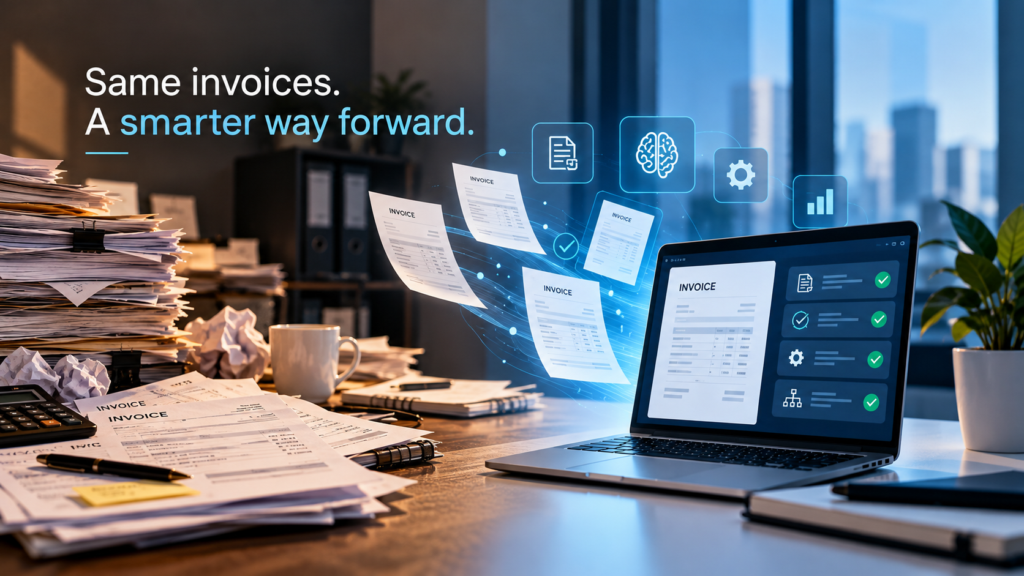

Every invoice that reaches your company asks the same quiet question: should we pay this, exactly as written? Invoice processing is how accounts payable answers it, thousands of times a month.
When it works, nobody notices. When it doesn't, you get late fees, angry suppliers, duplicate payments and, most often, small overcharges that slip through because nobody had time to check every line.
The gap between teams that struggle and teams that don't is rarely about software or headcount. It's about habits.
Here are eight invoice processing best practices that separate the two.
What good invoice processing looks like
Before the habits, the shape. In a healthy invoice processing flow, clean invoices go straight through and people only touch the ones that don't match.
Clean invoices flow straight to payment; only exceptions reach a person
- Receiveone front door
- Read every linesame way every time
- MatchPO and receipt
- Approve and payno touch needed
Every best practice below makes one of these steps faster, more accurate or harder to skip.
8 invoice processing best practices
1. Give invoices one front door
Invoices that arrive in ten inboxes, two portals and someone's desk drawer get lost, paid twice or paid late. Send every supplier to one address or one channel, and pull the ones that live in supplier portals automatically instead of logging in by hand.
2. No PO, no pay (where it makes sense)
A purchase order is what makes an invoice checkable. For goods and recurring services, ask for a PO number on every invoice and send back the ones without it. For spend that has no PO, like telecom, cloud or utilities, the contract plays the same role.
3. Check every line, not just the total
This is the habit that saves the most money. An invoice can match the PO total and still be wrong: one unit price above the agreed rate, one item billed but never delivered, one fee charged twice. Those errors only show up line by line.
4. Match three ways
Compare each invoice line with what was ordered (the PO) and what actually arrived (the goods receipt). Two-way matching catches price errors. Three-way matching also catches paying for things you never got.
5. Read invoices the same way every time
If two people, or two runs of a tool, can read the same invoice differently, you can't trust the result or audit it. Consistent, rule-based reading means the same document always produces the same data.
6. Route only the exceptions to people
Your AP team's time is best spent on the invoices that don't match. Let the clean ones flow straight to approval, and send each exception to a named owner with the reason and the evidence attached.
7. Close the loop with suppliers
An overcharge you catch but never recover is just paperwork. Track every dispute until there's a credit note or a corrected invoice, and use the history to have better conversations with repeat offenders.
8. Look out for duplicates and fraud
The same invoice can arrive twice from two channels, with a slightly different number. Check for duplicates before payment, and verify any change to a supplier's bank details through a separate channel.
How to know your invoice processing is working
You can't improve what you don't measure. A handful of numbers, reviewed every month, tells you more than any dashboard:
| Metric | What it tells you |
|---|---|
| Cost per invoice | How much effort each invoice takes, all in |
| Cycle time | Days from receipt to approval, and whether you're catching early-payment discounts |
| Touchless rate | Share of invoices that go through with no manual work |
| Exception rate | Share of invoices that need a person, and why |
| Lines checked | Share of invoice lines validated, not just totals |
| Amount recovered | Overcharges caught before payment or credited after |
Start with today's numbers, even if they're rough. Improving any of them is much easier when you know where you began.
The bottom line
Good invoice processing isn't about working faster. It's about checking the right things, every time, and letting people focus on the invoices that actually need them.
That's the idea behind Asignet's invoice validation. We use AI to build a reader for each new invoice layout, then read every invoice with WAYFAST AI, our own technology, and check every line against the purchase order, the receipt or the contract. Robots pull invoices from supplier portals, and our team handles disputes until the credit comes back. Your team only sees the differences, each with its evidence.
Want to see what a line-by-line check would find in last month's invoices? Book a demo.