Ask five people in a company what "spend" means and you'll get five answers. For the travel manager, it's flights and hotels. For procurement, it's suppliers and contracts. For IT, it's licenses, cloud and phone lines. For accounts payable, it's the pile of invoices waiting to be paid.
Business spend management brings all of those answers into one picture. This guide explains what it is, how it differs from business expense management, what it covers and how to put it into practice.
What is business spend management?
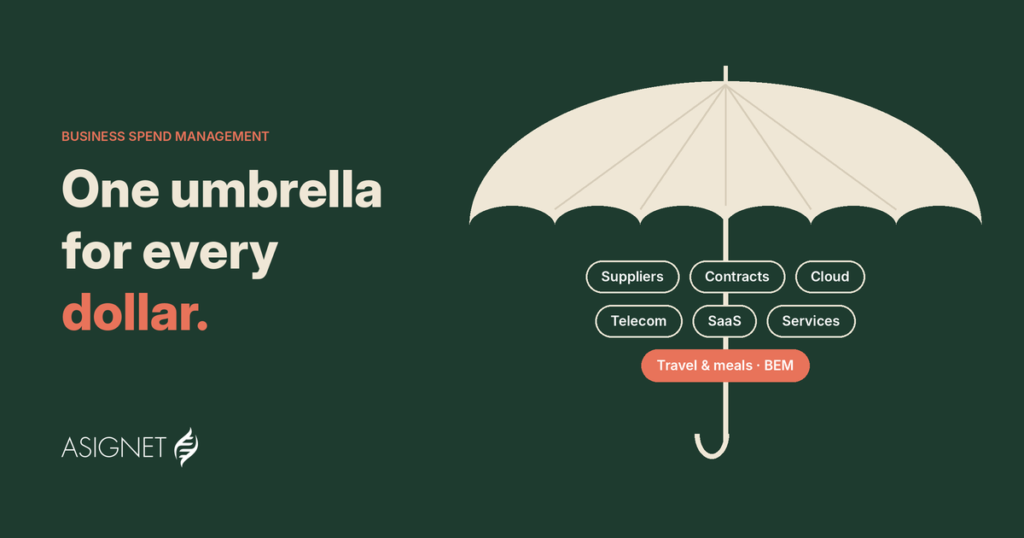
Business spend management (BSM) is the practice of controlling every dollar a company spends, from the moment someone needs something to the moment the invoice is paid and recorded. It covers procurement, contracts, invoices, payments, employee expenses and the analysis that ties them together.
The goal is simple: know what you're spending, with whom, under which terms, and whether you're paying the right amount. In practice, BSM connects processes that usually live in different teams and systems.
What is business expense management (BEM)?
Business expense management (BEM) is the part of spend management focused on employee-initiated, out-of-pocket costs: client lunches, travel, mileage, hotel stays, conference fees and similar purchases that employees pay for and then submit for reimbursement or charge to a company card.
BEM handles receipts, expense reports, policy checks, approvals and reimbursements. It's important, but it's only one slice of what a company spends.
Business spend management vs. business expense management
The short version: BSM is the umbrella; BEM is one category under it.
| Business spend management (BSM) | Business expense management (BEM) | |
|---|---|---|
| Scope | All company spending | Employee-initiated, out-of-pocket costs |
| Typical spend | Suppliers, services, IT, telecom, cloud, SaaS, facilities, plus employee expenses | Travel, meals, mileage, client entertainment, small purchases |
| Who initiates it | Procurement, IT, operations, employees | Individual employees |
| Key documents | Contracts, purchase orders, receipts, vendor invoices | Receipts and expense reports |
| Main controls | Approvals, contract compliance, invoice validation, spend analysis | Expense policy, receipt checks, reimbursement approval |
| Main owner | Finance, procurement and AP together | Finance or a T&E team |
| Share of total spend | All of it | Usually a small part of it |
BEM vs BSM: why the difference matters
Many companies invest in BEM because it's visible: everyone files expense reports. But most money leaves through vendor invoices, contracts and recurring services, which BEM never sees. A company can have perfect expense reports and still overpay a carrier, a cloud provider or a software vendor every month.
That's why it pays to treat BEM as one piece of a broader BSM program, not as the whole thing.
What business spend management covers
| Area | What it includes | How Asignet helps |
|---|---|---|
| Sourcing and procurement | Requests, approvals, supplier selection, purchase orders | Smarter Automation |
| Contracts and vendors | Terms, rates, renewals, vendor records | Business Spend Management |
| Invoices and accounts payable | Receiving, validating and approving vendor invoices | Invoice Validation |
| Disputes and recovery | Getting credits for billing errors | Billing disputes |
| Technology spend | Telecom, mobile, cloud and SaaS | Telecom, Mobile, Cloud, SaaS |
| Employee expenses (BEM) | Travel, meals, reimbursements | Usually a dedicated expense tool, connected to the rest |
| Spend analysis | Reporting by vendor, category and cost center | Part of the Asignet platform |
Why business spend management matters
- Fewer overpayments. When invoices are checked against contracts and what was received, billing errors are caught before payment.
- One view of spending. Finance sees vendor, technology and employee spend side by side, instead of in separate reports.
- Stronger negotiations. Usage and spend data by vendor gives procurement facts to negotiate with.
- Less maverick spend. Clear approval paths make it easier to buy the right way than around it.
- Faster close and cleaner audits. Every request, approval, invoice and payment is recorded in one place.
Business spend management best practices
- Start with visibility. Bring vendor, technology and employee spend into one view before trying to optimize any of it.
- Tie every vendor to a contract. Store prices and terms as data so invoices can be checked against them.
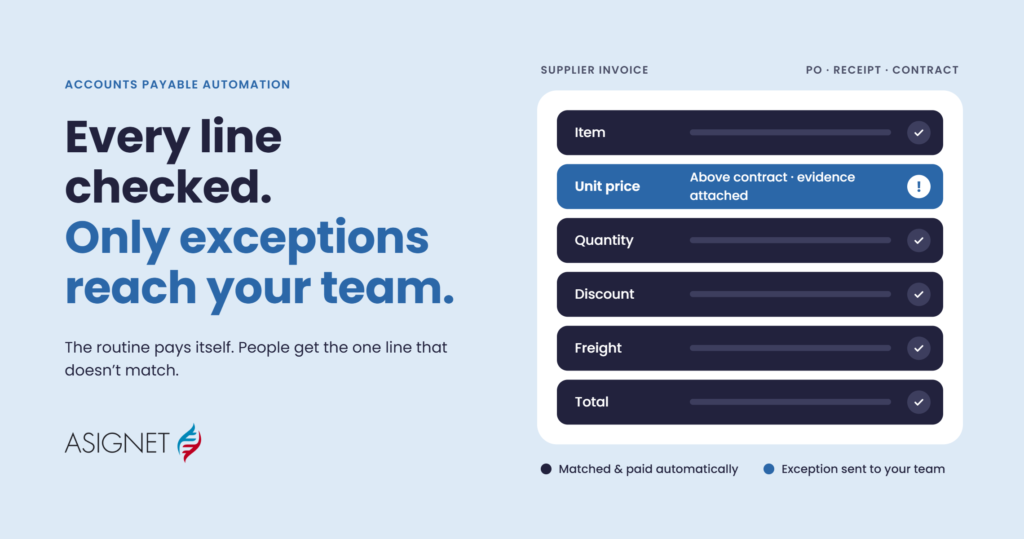
- Validate invoices line by line. Totals can match while individual lines are wrong. Check every line against the contract, the PO and what was received.
- Don't stop at BEM. Expense reports are a small share of spend; recurring vendor and technology bills are where most savings are.
- Automate the repetitive work. Use robots for portal downloads, rules for approvals and parsers for invoice data, and keep people on the exceptions.
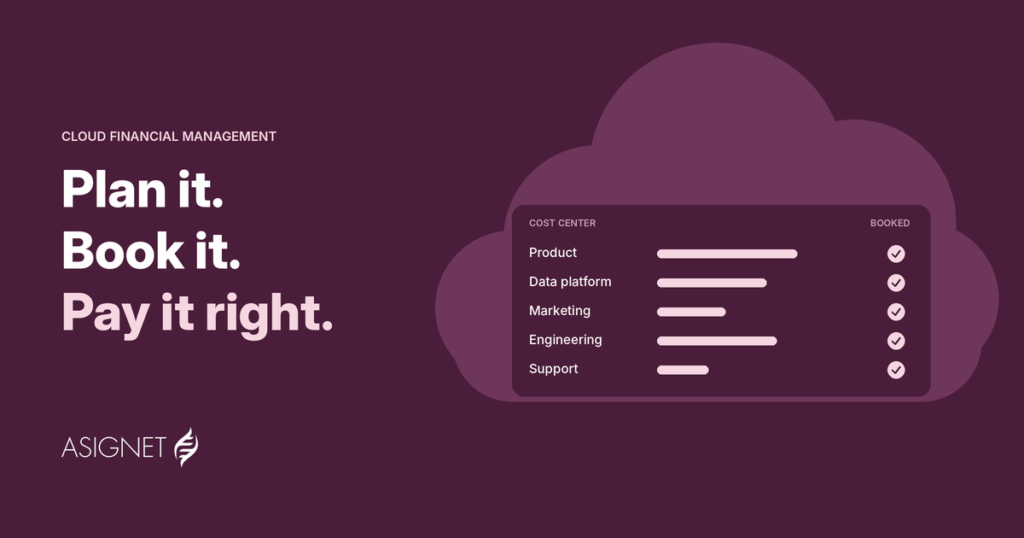
- Allocate spend to owners. Every cost should land on a cost center someone is responsible for.
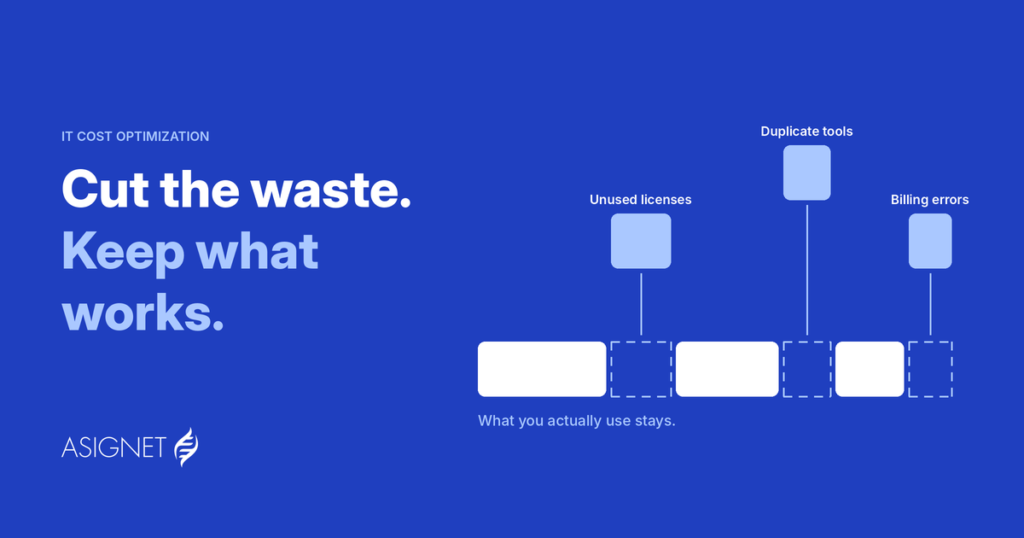
- Review vendors regularly. Use spend data before each renewal to decide what to keep, consolidate or renegotiate.
Choosing cloud-based expense management software for BSM
Most BSM programs run on cloud-based software, but tools differ a lot in what they cover. When you evaluate cloud-based expense management software, ask:
- Does it cover vendor spend, or only employee expenses? Many expense tools stop at receipts and reimbursements.
- Can it validate invoices against contracts, line by line? Not just approve totals.
- Does it handle complex bills, like telecom, cloud and SaaS, where errors are most common?
- Can it pull invoices from vendor portals automatically?
- Does it connect to your ERP, AP and HR systems?
- Is there a team behind it to handle disputes and keep the setup current?
How Asignet approaches business spend management
Asignet's Business Spend Management brings vendor and technology spend into one platform, validated before payment:
- Invoice validation that checks vendor charges against approved terms and recorded services, and flags incorrect charges, duplicates and unauthorized services.
- Approval and workflow automation that routes spending through defined approval processes.
- Vendor and contract tracking that keeps agreements and suppliers visible in one place.
- Automated provisioning through workflows or AI-driven agents.
- Cost optimization and allocation that finds unused services and links each cost to users, cost centers and locations.
Asignet focuses on vendor and technology spend, where invoices are long, complex and easy to overpay. Employee expense tools can connect to the same financial systems, so finance still gets one complete picture.
See all your spend in one place
Asignet validates every vendor and technology invoice against your contracts, routes approvals and recovers billing errors for you. Explore Business Spend Management and Invoice Validation.
Frequently asked questions
What is business spend management?
Business spend management (BSM) is the practice of controlling all company spending, from request and approval to invoice validation, payment and analysis, across suppliers, services, technology and employee expenses.
What is business expense management (BEM)?
Business expense management is the part of spend management that handles employee-initiated, out-of-pocket costs, such as travel, meals and mileage, through expense reports, policy checks and reimbursements.
What is the difference between business spend management and business expense management?
BSM is an umbrella term that includes all company spending. BEM is one sub-category of BSM focused only on employee-initiated, out-of-pocket costs.
BEM vs BSM: which one does my company need?
Most companies need both. BEM handles employee expenses; BSM covers everything else too, including vendor invoices, contracts and technology spend, which usually make up most of what a company spends.
What is cloud-based expense management software?
Software that runs in the cloud to capture, validate, approve and report on spending. Some tools only handle employee expenses; others, like Asignet, validate vendor and technology invoices against contracts before payment.