You might be wondering how Asignet’s tools help reduce telecom and IT costs. A few factors come into play in auditing and savings. We keep track of contracted inventory and active services, and a key part of our approach is that our inventory is matched to our billing and expense management.
Connected Inventory, Billing and Provisioning
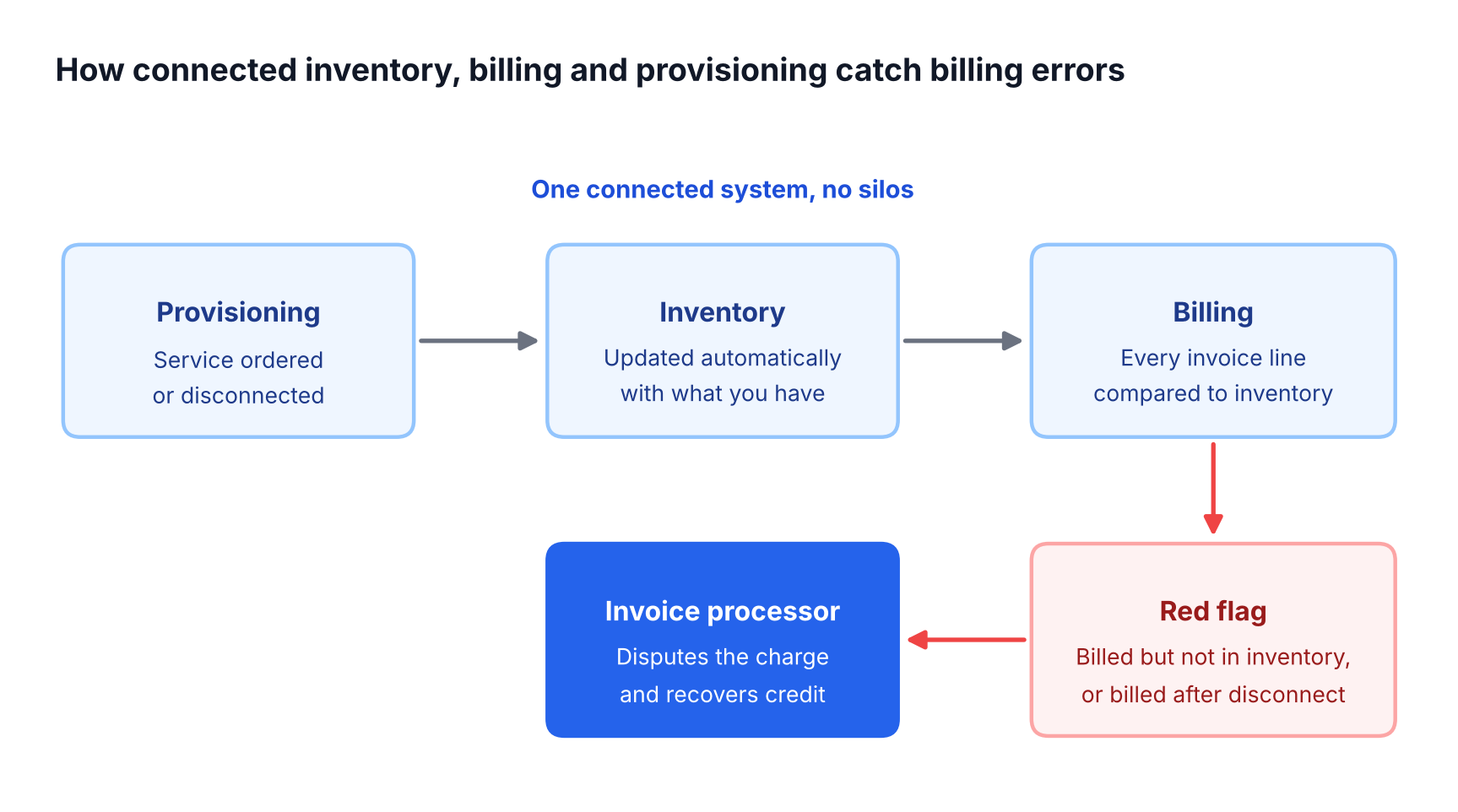
Our inventory and billing systems speak to each other and connect automatically. That is unlike providers that keep separate inventory and billing systems, which creates silos in the process.
Because these processes are connected, you can see the full picture: what’s being billed, what’s no longer being billed and, through the provisioning process, what should be disconnected. When something is billed that shouldn’t be, it shows up in billing and expense management as a red flag for our invoice processors.
These indicators tell us instantly that something is wrong, and our flags and alerts make sure errors are caught. Once your inventory, expense management and provisioning are tied together, the whole process works as one.
Telecom expense management (TEM) and wireless expense management (WEM) solutions no longer focus only on telecom expenses. Many now address technology expenses and data security too. With the convergence of telecom, IT and mobile offerings, expanding into IT and security was a natural step. As a result, justifying these programs on cost savings alone is too limiting.
Robotic Process Automation
These are the key drivers behind how robotic process automation (RPA) transforms business:
- Cost reduction: software robots typically cost far less than the staff time needed to perform the same tasks manually.
- Efficiency: RPA can run 24/7 without breaks, as long as the underlying core applications are available.
- Accuracy: people make data entry mistakes, while robots perform the same task the same way every time, as long as no judgment call is required.
- Audit and regulatory compliance: robots provide detailed audit logs that enable advanced business analytics and improved compliance.
- Easier change management: robots preserve application and data integrity by working through the existing application interface and reusing existing application logic, databases and validation, without deep re-engineering.
They say there’s nothing as powerful as an idea whose time has come. The time for RPA-powered transformation is now.
Wayfast
Asignet’s technology captures process gaps and anything that isn’t yet automated, and issues can be fixed and corrected quickly through Wayfast. Wayfast is a platform designed for both IT and telecom teams and business users, combining full-cycle web application development with a workflow and business process management (BPM) product so each group can make the most of its skills.
Wayfast allows business users to create simple or complex solutions in a fraction of the time traditional application development takes. Starting from business requirements, its integrated Scrum methodology accelerates the analysis phase.
Its integrated prototyping engine lets you build a functional prototype in hours or days, not weeks or months. Once the prototype is approved, it is converted into the final web or mobile application, taking you from business need to working application quickly.
Wayfast is also designed to keep each page lightweight, which reduces the cloud bandwidth needed to run applications, saving money and improving efficiency from development through deployment.
Business users get tools to quickly create forms and business workflows without programming skills. IT staff can then enhance that first version by adding complex integrations or turning the web form into a sophisticated web app.
Wayfast integrates with other applications through either an SOA or a legacy interface, thanks to its patented integration engine (US Patent 7,702,773), and its prototyping module helps users quickly understand their needs.
Because you can build workflows and applications with almost no code, Wayfast lets you customize workflows and create reporting based on your IT and telecom infrastructure requirements. It delivers accurate, fast process development, full process traceability and low implementation costs. Its prototyping engine lets users see their needs reflected in the system quickly, which makes those needs easier to understand and define.
GlassBox
The technology behind billing, inventory, provisioning and trouble ticketing has changed dramatically in recent years, and the pace continues to accelerate. Today’s fixed, mobile, cloud and SaaS portals deliver real-time self-service.
That self-service brings new security risks. Security leaders need to update their organization’s threat profile to account for them and put a formal plan in place to manage them proactively. Otherwise, they risk becoming soft targets for attackers looking to spy, steal data, launch distributed denial-of-service attacks, escalate privileges or disrupt operations in other ways.
Asignet’s proprietary GlassBox technology encrypts usernames and passwords and allows single sign-on to all your enterprise portals. It also lets our team work with your data in a “glass box” virtual server that does not allow data to be removed or downloaded.
GlassBox is fully integrated into Asignet’s TEM, managed mobility services (MMS) and IT asset management (ITAM) platform. Schedule a meeting to see it in action.
A Growing Security Risk
As the functionality of self-service IT and telecom portals advances, so do the security risks. The question is how third-party TEM providers, value-added resellers (VARs), consultants and auditors manage that growing access.
It is not only about securing usernames and passwords, but also the content inside these portals. In the wrong hands, this access and information can have catastrophic results. TEM providers, VARs, consultants and auditors must take measures today to secure this information and keep pace with advancing portal technology.
Contact Asignet to learn more about how our tools can reduce your telecom and IT costs.