Software license management is the process of making sure your organization uses software in line with its license agreements, while providing accountability across the organization, whether it’s large or small.
It tracks which licenses you own, who they’re assigned to, when they were approved and how they’re used, so usage never exceeds what you’re entitled to and you don’t pay for more than you need. Many companies struggle with this today, and they waste money and take on audit risk as a result.
License management requires more than knowing how many licenses are in use. It also means understanding who has access to which tools, where they’re used, which license terms apply and whether users have their own accounts for company-managed services.
Hyperautomation makes this manageable. It replaces manual processes with a single platform for managing software licenses across the enterprise, giving you complete visibility into usage by user, department and organization. That lets you control costs and see where you need more licenses, or fewer.
These seven best practices will help you manage your software licenses efficiently and save time and money.
1. Understand Your License Models and Terms
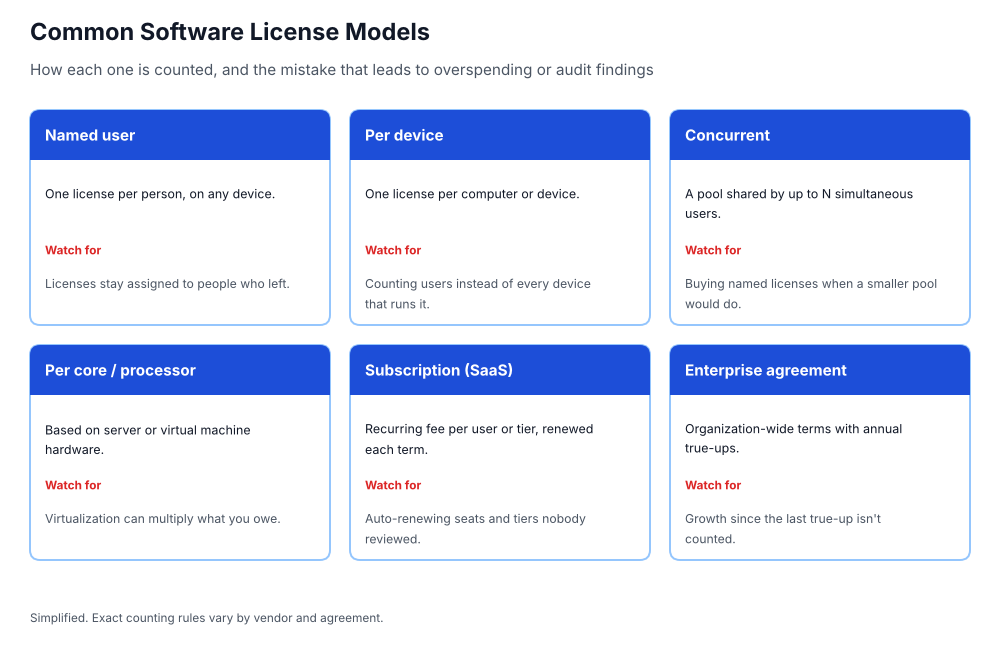
Compliance starts with knowing what you agreed to. Software is licensed in many ways, such as per user, per device, per processor core or by subscription, and each model is counted differently. Read your agreements for usage rights, renewal terms, true-up requirements and audit clauses, so you know exactly what you’re entitled to use.
2. Keep a Central Record of Every License
Store all license entitlements, proofs of purchase, contracts and renewal dates in one place. A central record makes it easy to compare what you own with what you use, and it’s the first thing you’ll need if a vendor audits you. Not all license tracking tools are created equal, so choose one that can capture every type of license your organization uses, including SaaS and cloud subscriptions.
3. Organize Users Into Groups
Make sure every person or device using a program is associated with an account in your system. Group them by department, role (such as managers or developers) and the devices they use. That ensures accountability when it’s time to check how many seats each department and user is using.
4. Track and Document Actual Usage
Monitor usage of every software product, on-premises and in the cloud. Usage reports show which licenses are actively used, which aren’t, and where demand is exceeding what you’re licensed for, so you can find out why and correct it before it becomes a compliance problem.
Integrating license management with your user directory, such as Microsoft Entra ID or Active Directory, keeps license assignments in sync with who actually works at the company and what their role is.
5. Automate Provisioning and Approvals
Automate as many license processes as possible, including user provisioning, device registration, requests for new or different licenses, approval workflows and usage reporting by department. Hyperautomation handles these processes around the clock, across devices, platforms and locations, which is especially valuable for distributed workforces. It also keeps license counts accurate in real time, so assignments don’t exceed what you’re entitled to.
6. Reclaim Unused Licenses
Software that no one uses still costs money. Use automation to maintain accurate usage records, then reclaim licenses from inactive users and former employees and reassign them before buying new ones. Remove licenses you don’t need at renewal.
7. Keep Everyone Informed and Stay Audit-Ready
Keep your team updated on new license agreements and changes to existing ones. When everyone understands the terms that apply to them, they don’t need to contact support every time an agreement changes, and they’re less likely to install or use software in ways that break the rules. Keeping usage records and entitlements current also means a vendor audit becomes a routine request rather than an emergency.
Put Software License Management on Autopilot
The foundation of software license management is knowing what you own, who uses it and how, and keeping that information current. Hyperautomation does that continuously, so you can stay compliant, remove unnecessary licenses and keep your team informed without the manual effort.
Asignet’s IT asset management and SaaS management solutions use hyperautomation to give you complete visibility into software licenses across your organization. Talk to Asignet to learn more.