
The benefits of hyperautomation are becoming more apparent as businesses look to improve their processes, and telecom expense management (TEM) is a prime example. Automating TEM processes increases productivity, because teams no longer spend so much time on work that software robots, using robotic process automation (RPA), can do for them.
The Benefits of Hyperautomation for Telecom Expense Management
Hyperautomation helps with cost containment and process efficiency. It can recover money lost to inefficient processes and help identify wasteful practices before they add up.
It also supports regulatory compliance by automating the tasks compliance requires, while still following organizational policies.
The potential savings are significant. Gartner predicted that organizations combining hyperautomation technologies with redesigned operational processes could lower operational costs by 30%. Key benefits include:
- Fewer errors and higher accuracy by eliminating manual work.
- Greater efficiency, which saves time and money.
- Better decisions, because algorithms can process far more data than people at any given time, and analytics and predictive modeling surface insights faster.
- Lower costs, by scaling operations without adding headcount at the same rate.
- Better customer service with shorter wait times.
- More time for employees to focus on strategic work instead of mundane, routine tasks.
Benefits of Hyperautomation for Finance and Procurement
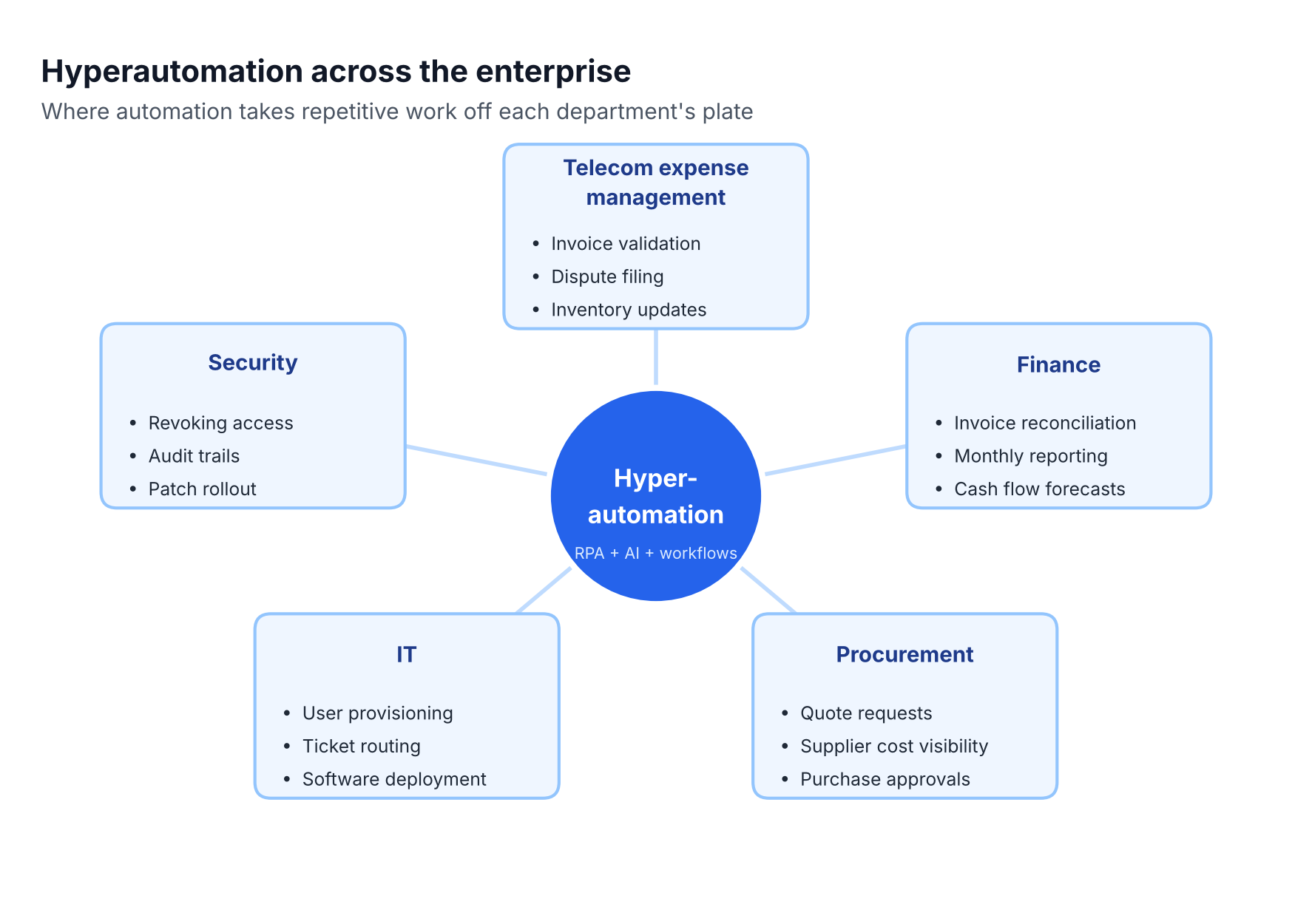
Finance teams can automate manual tasks such as reconciling invoices and producing monthly reports, freeing them for higher-level responsibilities like strategy development. Hyperautomation also helps finance teams meet security and compliance requirements.
For procurement, hyperautomation provides better transparency into supplier costs, which helps teams avoid overpaying and negotiate better pricing. It also streamlines purchasing by automating administrative tasks such as sending requests for quotes and routing approvals, which saves time and improves supplier relationships.
Benefits of Hyperautomation for Security
For security teams, automation helps reduce risk by applying security tasks consistently and around the clock, even when the team isn’t staffed 24/7. For example, it can remove system access as soon as an employee leaves, roll out patches on schedule and keep a complete audit trail of every automated action.
Benefits of Hyperautomation for IT
By automating redundant and repetitive tasks, RPA reduces the time IT staff spend on them. IT operations become more streamlined and can scale up easily when projects need more resources, and IT staff can be assigned to more strategic work.
Why Hyperautomation Will Be Key in the Years Ahead
Hyperautomation will change the way businesses operate. It is also creating new kinds of work, as organizations need people to design, manage and improve automation, and skills in AI and machine learning are in high demand.
RPA can do more than automate processes like invoicing. It can also generate useful insights about business activity, such as forecasting future cash flows to help you plan ahead. Hyperautomation reduces wasted resources that would be better used elsewhere in the organization.
As more companies automate their workflows, it is becoming increasingly important to automate as much of each process as possible. That helps managers and employees and reduces operational costs, improving the bottom line. The goal is an intelligent workforce that adapts quickly to change rather than being replaced by it.
Hyperautomation means better processes, more reliable results and faster response times, along with fewer human errors. It also creates opportunities to improve performance across every department, because robots can complete repetitive or error-prone tasks much faster than people can.
Talk to Asignet about bringing hyperautomation to your telecom and IT expense management.