The telecom expense management (TEM) industry has been one of the most enthusiastic adopters of IT over the last 20 years, keeping pace with technological disruption to ensure better customer connections. As robotics, machine learning and artificial intelligence (AI) fundamentally transform the way companies deliver services in an on-demand economy, telcos need to revisit some of their long-held operating values.
With innovative technology, telcos are implementing robotic process automation (RPA), and they need to evaluate their existing IT infrastructure and application systems against their business priorities.
Advanced technologies such as automation, cloud computing and AI help carriers transform their core operations and realize business outcomes faster, for a higher return on investment (ROI).
From an operational standpoint, this means telcos’ manual, expensive and time-consuming processes are replaced by automated software solutions that are more reliable and agile.
What TEM Solutions Do
TEM solutions help you manage your organization’s network infrastructure provided by telecom carriers and hardware providers throughout your lifecycle with them. This includes procuring new services, managing inventory, invoice processing, support and maintenance.
A TEM system also gives everyone, from procurement, IT network managers and finance teams to auditors and IT leaders, a better way to manage the internal and external interactions and relationships that drive integrated processes.
A great TEM tool helps you manage and keep a record of all move, add, change and disconnect (MACD) requests. It provides a centralized repository of your inventory and contract terms, which is used to validate supplier invoices, and puts this information in one accessible location for anyone at your company who needs it.
With visibility and easy access to data, it is easier to collaborate and increase productivity. TEM can help companies of all sizes drive business growth, and it can be especially beneficial to smaller businesses, where teams often need to do more with less.
Everyone in your company can see your vital network information and understand your costs: what you’ve bought, when you last purchased it, what you paid and much more.
How Telecom Carriers Benefit From RPA-Based TEM Solutions
A TEM solution based on RPA gives you a clear overview of your entire network spend, suppliers and network performance in one place. It can also show you outstanding carrier order statuses, open network outages, services coming up for renewal in the next 30 to 60 days and much more.
- Finance teams can validate supplier invoices to confirm that what you pay matches your network inventory and agreed contract rates.
- Sourcing and procurement teams can track the pipeline of contract renewals, benchmark network costs and manage RFPs.
- IT network management teams can use TEM beyond invoice validation, embedding it into the business to support supply chain management. Some of the most significant productivity gains come from this step.
- Project teams and carriers get a single platform for managing pricing inquiries across internal and external channels, without losing track of requests.
The potential benefits of RPA in IT infrastructure are significant. By executing manual, rules-based tasks faster and more efficiently, software robots can reduce costs and drive noteworthy reductions in cycle times across many areas of operations.
Without a common platform for carrier interactions, communications can be missed or lost in the flood of information, leading to slow or unsatisfactory response times. Using RPA to provision new services tied to contracts, or to deprovision departing customers on an automated schedule, frees up capacity that can be sold to other customers.
Even if you successfully collect all this data, you still face the challenge of making sense of it. Extracting intelligence can be difficult, and reports can be hard to create and waste valuable time.
IT leaders and managers can also lose sight of what their teams are doing. That means they can’t offer the right support at the right time, and a lack of oversight can lead to a lack of accountability.
Example: Automating a Common Task With RPA
PowerShell Desired State Configuration (DSC) is a server provisioning and configuration management technology. It allows an administrator to define common settings in a configuration script, which can then be applied as many times as needed, whether once or thousands of times, with the same result.
There are dozens of PowerShell DSC resources that help build a DSC configuration and expose properties the administrator can configure through RPA.
Practical Application
Building a web server is a common task for administrators, and Internet Information Services (IIS) is the web server many organizations use to host websites. Here’s how DSC and PowerShell automation can be applied to this common IT task, building an IIS web server repeatedly through a workflow and RPA, to save an organization time and money.
Asignet’s patented robot includes a PowerShell class for running PowerShell automation scripts. Through a workflow created in Asignet’s Wayfast platform, the robot uses PowerShell and DSC to install IIS. This allows IT departments to automate repetitive tasks, saving time and money and reducing errors.
Server provisioning is a perfect candidate for automation because the golden image, with its software and configuration settings, stays the same with each new deployment.
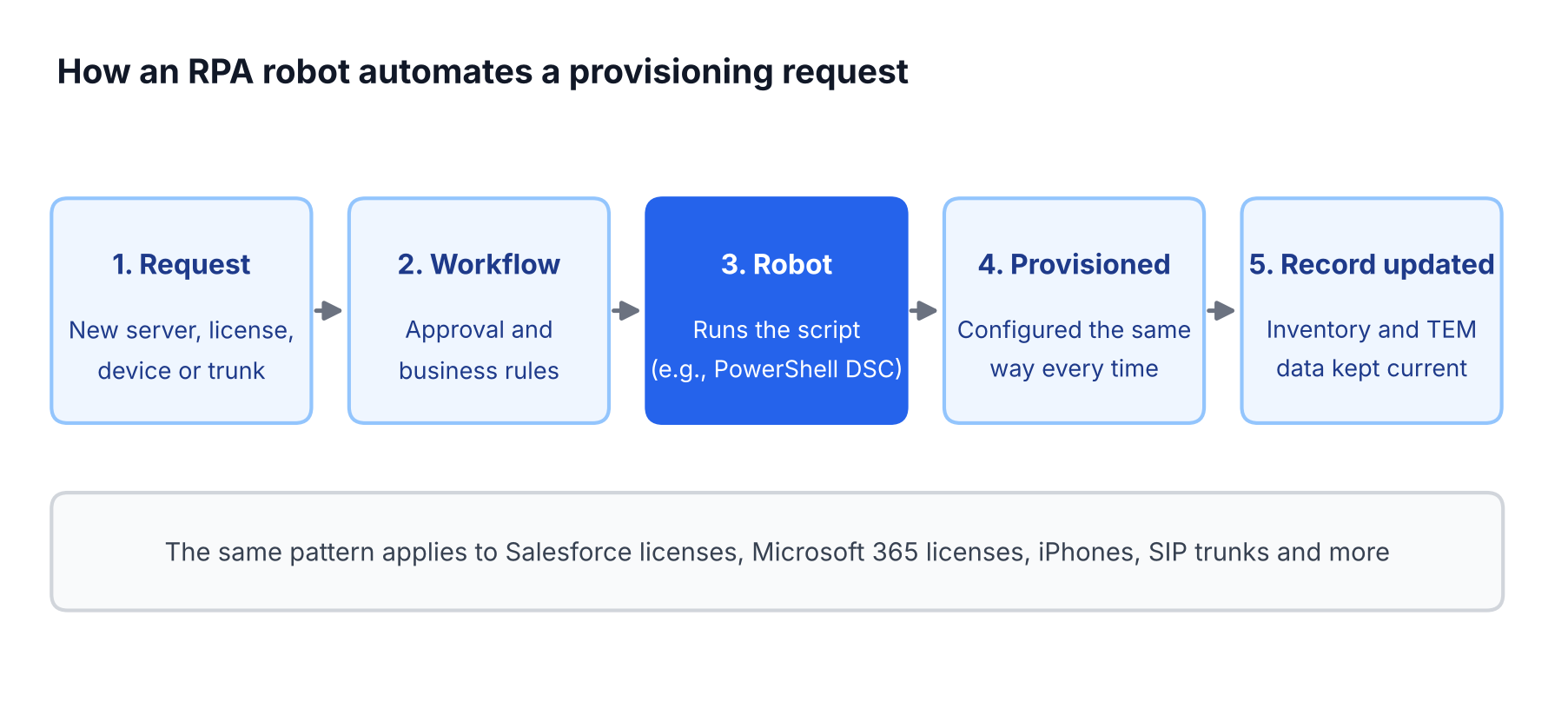
The same robotic automation applies to provisioning Salesforce licenses, Microsoft 365 licenses, iPhones, SIP trunks and more. Combining the robot with workflow creation, HR and Active Directory integration, and expert staff creates a true bridge between telecom expense management (TEM), wireless expense management (WEM) and IT asset management (ITAM).
Contact Asignet to learn more about our telecom expense management solution.