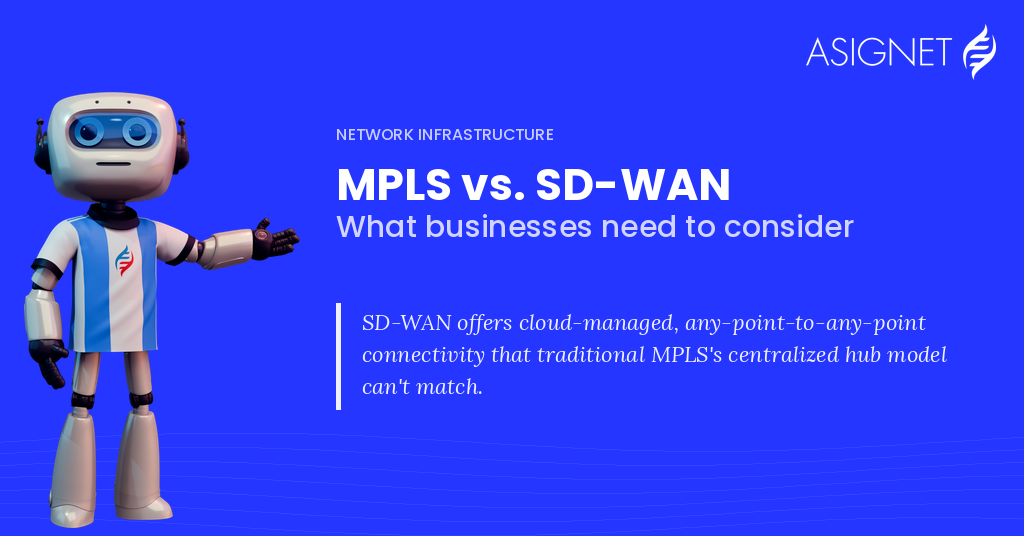
The main difference between MPLS and SD-WAN is that SD-WAN can be managed entirely in the cloud, routing traffic in the most cost-effective and efficient way.
When evaluating network performance, you need to consider the factors behind performance degradation and bandwidth exhaustion, how they affect traffic on your network and, ultimately, your business.
These issues should lead network managers to consider how smarter network management solutions could alleviate them. So let’s look at some of the factors that drive the decision of whether, and when, it makes sense to switch from MPLS to SD-WAN.
What Is MPLS?
Multiprotocol Label Switching (MPLS) is a very mature service provider technology that connects private sites, branch networks or public cloud into private networks, using any mainstream data transmission protocol. Before cloud infrastructure and services, these were fixed connections running from the provider to an enterprise or hosted MPLS switch. With the spread of cloud services, they now typically connect to the enterprise through a private or hybrid cloud.
One major advantage of MPLS is that it is a very secure and robust connection type. When provided by a carrier, it typically includes service assurances and service level agreements (SLAs) in addition to transport.
Running as a secure private tunnel within the provider’s network, MPLS works much like a multiprotocol VPN that connects discrete network points. It provides the advantages of older transport technologies such as Frame Relay and ATM without their overhead, while keeping the traffic engineering features they offered.
The Disadvantages of MPLS
- It is bandwidth-intensive. MPLS must follow a defined path to move its payload from point to point, which suits older environments where enterprises bought large data pipes and traffic moved between defined paths. It is less suitable for today’s dynamic networks, where packets are more sensitive to quality of service (QoS) issues depending on the size and type of traffic. For example, with the growth of UCaaS, video conferencing is the norm, and that type of connection has zero tolerance for bandwidth contention. Today’s networks need dynamic management with the intelligence to make smart decisions based on many factors that can vary by transaction type.
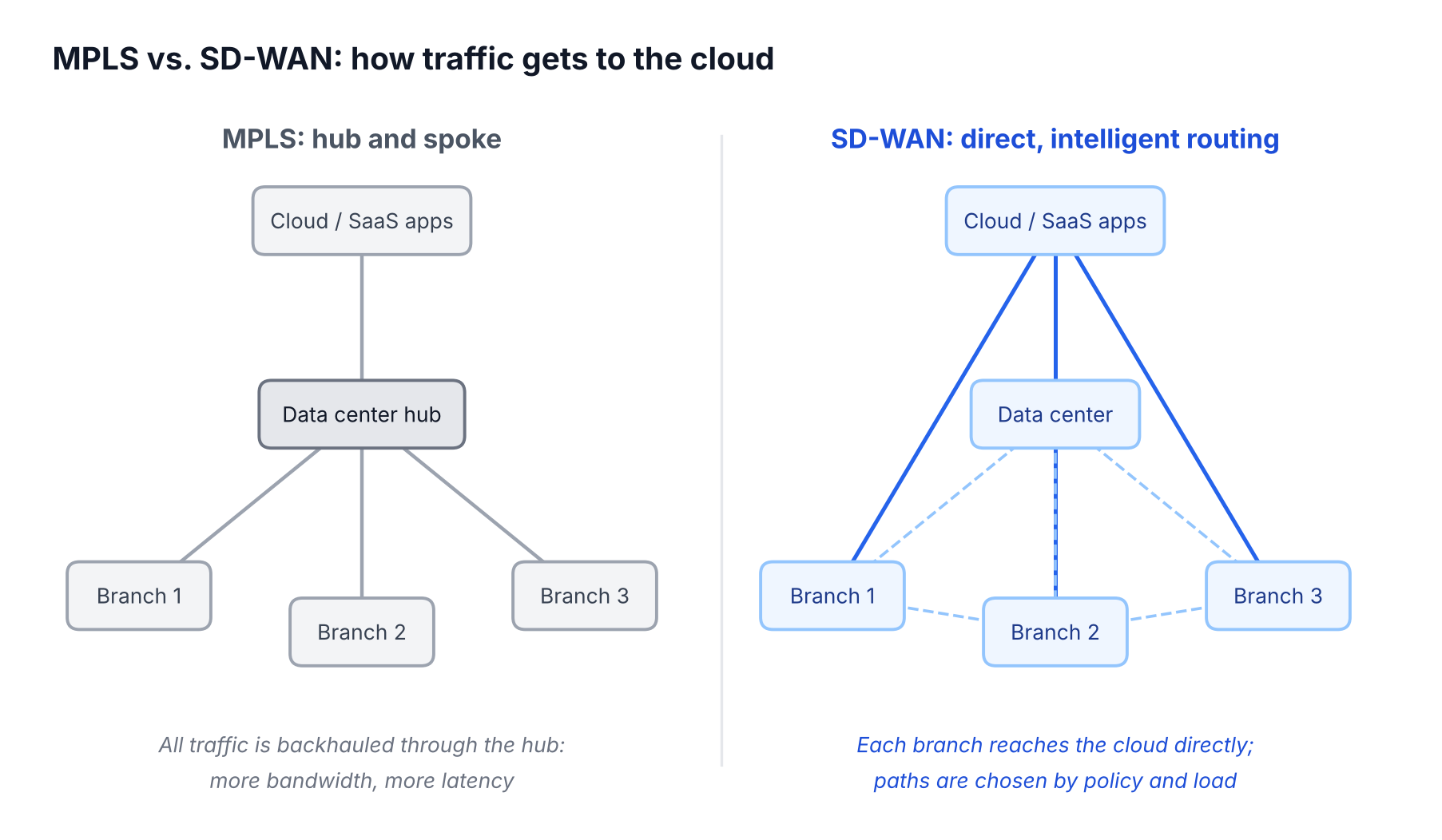
- It relies on a hub-and-spoke design. Traditional MPLS networks require all traffic to be backhauled to a data center hub to be processed and redistributed to its destination. This is inefficient, uses much more bandwidth and creates latency that is not acceptable in today’s distributed connection models.
- It does not inspect the data. MPLS uses only labels to decide where to send each packet next. It does not analyze the packet itself, so security still depends on client-side firewalls or other protocols. Without effective client controls, malware can spread easily through the network as MPLS routes it from one point to the next.
Enter SD-WAN
Software-defined wide area networking (SD-WAN) provides superior network agility and reduces costs compared with traditional WAN infrastructure.
Managed properly, it greatly increases connection flexibility while retaining and enhancing data security. It provides fully meshed, any-point-to-any-point connectivity, with the ability to route traffic intelligently over different paths based on QoS and security requirements and policies, bandwidth availability, traffic load and more. In essence, it adds a software layer between transport and applications for intelligent traffic engineering.
The single biggest difference between SD-WAN and traditional WAN or MPLS infrastructure is that the WAN can be managed entirely in the cloud. No matter where an application is hosted, whether on-site, in a public, private or hybrid cloud, or by a SaaS provider such as Salesforce, Concur, Microsoft 365 or AWS, SD-WAN provides the intelligence to manage connectivity in the most cost-effective and efficient way.
This compares very favorably with a traditional WAN architecture, where all traffic had to be backhauled to a central data center for security and routing. That approach results in much higher circuit costs, as well as productivity and connectivity problems caused by traffic congestion.
Choosing the right SD-WAN service also matters, because offerings range from basic to robust business-class solutions. The difference lies in the amount and type of intelligence and security controls used to manage connectivity and data transport from endpoint to endpoint. Business-class services can handle near-instant switchover to alternate paths if a primary path fails, and touchless provisioning of security patches or policy updates to all nodes at once. Today, many enterprises also combine SD-WAN with cloud-delivered security in a secure access service edge (SASE) architecture.
Why Enterprises Are Switching to SD-WAN
What are the main reasons enterprises are adopting SD-WAN over traditional MPLS?
- Cost: MPLS infrastructure is expensive. SD-WAN is more affordable and uses mostly off-the-shelf components.
- Intelligent routing: SD-WAN is highly flexible and routes traffic intelligently. MPLS traffic must be backhauled for redistribution and may take multiple hops to reach its destination, which increases latency and congestion.
- Built-in security: SD-WAN offers built-in security capabilities. MPLS does not analyze packets for security; it only reads the header to decide where to route them.
- Efficiency and failover: MPLS requires more bandwidth because of backhauling, routes discretely from node to node and offers no built-in security inspection or intelligent failover. SD-WAN is more cost-effective and flexible.
How Asignet Brings Value to MPLS and SD-WAN Environments
Asignet’s Wayfast platform is a cloud-based, low-code platform that ties together IT assets, usage and cost in one holistic view. With native robotic process automation (RPA), it can build and run thousands of automated workflows, integrate with other systems and act on the data it collects. Asignet offers a full suite of IT asset management (ITAM), IT service management (ITSM), UCaaS and technology expense management (TEM) solutions and services.
Networks themselves don’t audit whether usage and any rented or leased equipment are billed at the contracted rates. Nor do they confirm that provider bills accurately reflect the assets in use, comply with the contract and contain no errors. Asignet adds that layer of audit, visibility, business intelligence and savings by integrating and analyzing data from disparate sources.
Asignet’s solutions for MPLS and SD-WAN environments include:
- An accurate baseline of all network inventory: Asignet discovers, loads and validates inventory information from providers and other sources, and can manage audit claims for any refunds due. An accurate inventory is also critical for clients considering, or in the middle of, a migration to SD-WAN.
- Discovery of all nodes, endpoints and usage: a passive client identifies all active and inactive endpoints, analyzes traffic patterns at each connection point and pinpoints under- or over-utilization and other inefficiencies.
- Turning down old lines and circuits after migration: it is common for old services never to be disconnected during a transition project. Recovering past amounts paid is sometimes possible.
- Equipment and maintenance management by location: during network migrations, equipment is often taken out of service while its maintenance contract keeps billing. This also helps determine whether to renew or replace gear at the end of its contract, based on manufacturer support, end of life and more efficient replacement options.
- Contract compliance: cloud services are billed very differently from traditional data services, and the billing is more complex. Asignet validates that the contracted rate for each service is correct and that billing is accurate based on both usage and contract.
- Automated workflows: notifications or automatic actions based on defined business rules for a given state or condition.
- Holistic business intelligence reporting: tying together inventory, usage, billing and location gives the enterprise actionable data for decisions based on facts, not guesswork.
Contact Asignet to learn more about these services, or to arrange a risk-free trial using a sample of your own data.