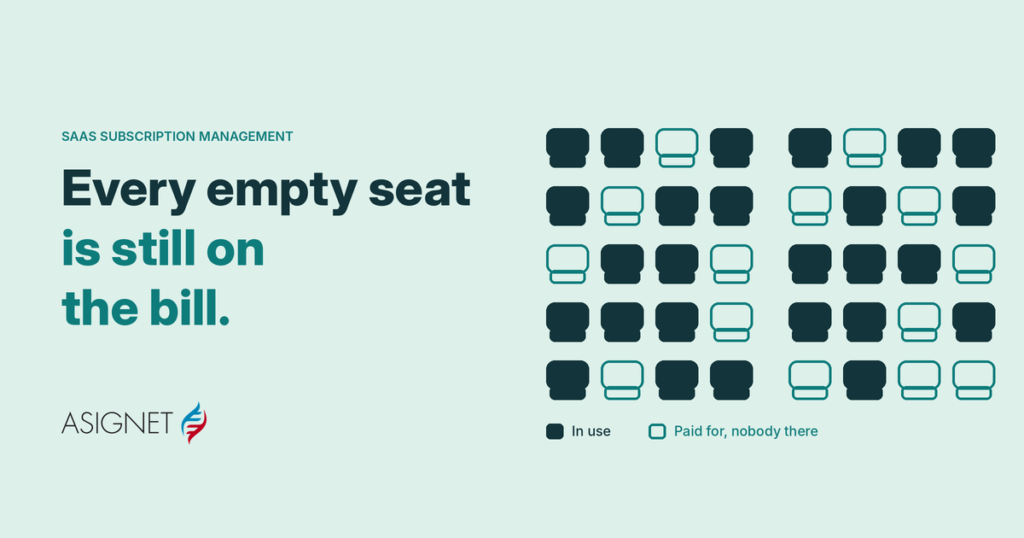
Large enterprises adopt software as a service (SaaS) to become more agile and cost-efficient. But managing what they spend on it comes with real challenges, especially lack of visibility, gathering data and analytics, and optimization. The cost of getting it wrong is high: according to the Zylo 2026 SaaS Management Index, the average organization uses only 54% of its SaaS licenses and wastes $19.8 million a year on the rest.
1. Lack of Visibility
The first obstacle is that large companies often can’t see all the SaaS they’re paying for. With so many applications in use, it’s hard to keep track of which services are active. Employees may not know which services they have access to, or how much their subscriptions cost each month.
Without that visibility, some people end up with more licenses or higher subscription tiers than they need, while others hold overlapping subscriptions they never use at the same time. That waste usually goes unnoticed until contracts come up for renewal. You need full visibility across all license types before making decisions on renewals and optimization.
When you start digging, the number of SaaS applications is likely to surprise you. You might think you have a handle on your productivity environment because Microsoft 365 and Google Workspace are so widespread. But each of those suites comes in several subscription tiers that bundle many separate applications. Microsoft subscriptions, for example, can include Teams, SharePoint and Dynamics 365, each with its own licensing. Salesforce and Adobe offer dozens of products and add-ons of their own. Then there’s Zoom, standalone task management tools, file storage services and any number of niche apps that individual teams sign up for on their own.
Add up every application, plus the integrations and add-ons that connect them, and the total grows quickly. Many companies have hundreds of SaaS applications without realizing it.
2. Gathering Data and Analytics
Optimizing SaaS spend depends on good data. Without the right tools, it’s difficult to tell which subscriptions each employee uses, whether they use them at all and how heavily.
Even once you understand your company’s SaaS and UCaaS usage and spending, controlling those costs is still a major challenge. Usage data is spread across dozens of vendor admin consoles, each with its own format, and collecting and normalizing it is a job few businesses have the tools to do well. Applying analytics to that data is harder still, but it’s critical to managing your SaaS environment.
Some businesses try to combine data from sources such as their single sign-on (SSO) system and general ledger (GL). This approach is time-consuming to set up and maintain, and the insight it provides is limited. SSO misses apps that employees sign into directly, and the GL misses subscriptions paid on corporate cards or bundled into other invoices, so you still get only a partial view of your company’s SaaS usage and true costs.
3. Optimization
The goal is to make SaaS spending more efficient and cost-effective. To get there, asset managers need to manage the entire SaaS lifecycle: discovery and monitoring, usage and analytics, optimization and, finally, termination.
Following SaaS asset management best practices means having up-to-date reports that are easy to read and understand, so asset managers can decide which apps to keep, downsize or cancel. Static, point-in-time reports don’t support that; they leave asset managers aiming at a moving target. And without visibility into the full inventory, optimizing SaaS spend is difficult, if not impossible.
How Automation Helps
SaaS management software addresses these challenges by bringing subscription, license, usage and invoice data into one place, where it can be used for analytics and reporting.
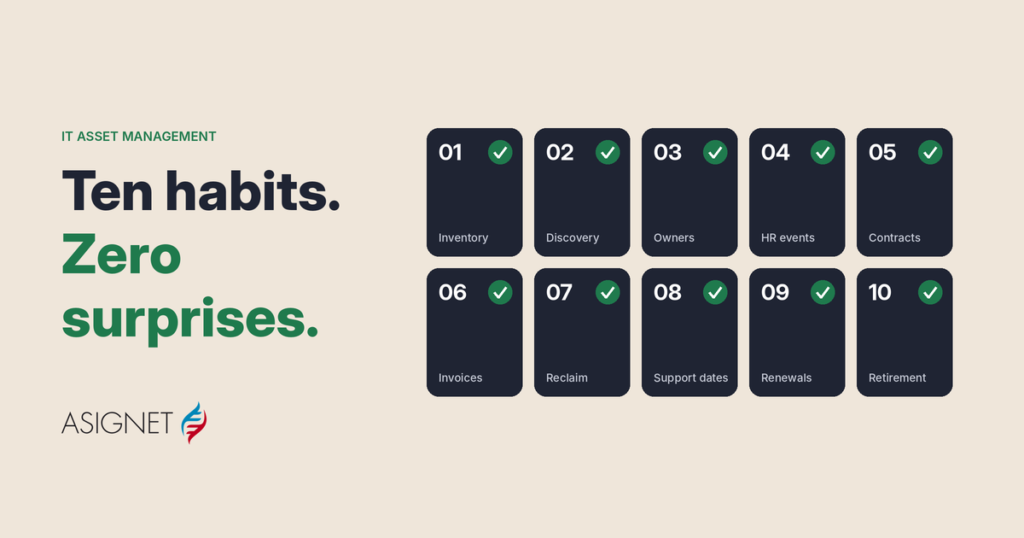
Platforms that use hyperautomation go a step further. They can automatically assign licenses when employees join or change roles, reclaim them when people leave or stop using an app, and flag subscriptions that are due for renewal or no longer needed. Asset managers get an accurate, continuously updated view of the whole SaaS lifecycle, so they can finally tackle challenges like optimization and security.
Asignet’s SaaS management solution uses hyperautomation to give you visibility and control over your SaaS licenses and spend. Talk to Asignet to learn how we can help.