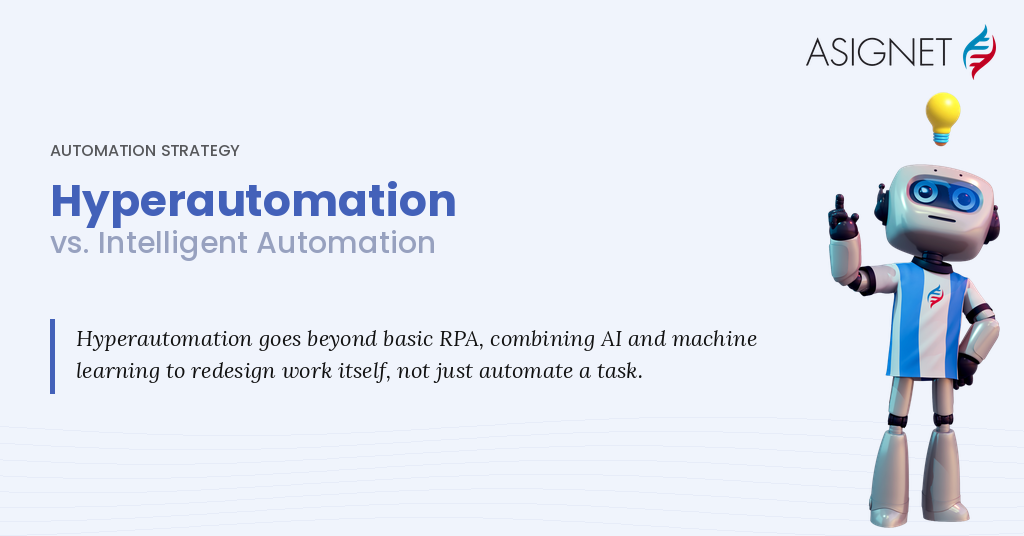
The main difference between hyperautomation and intelligent automation is scope. Intelligent automation is a set of technologies that combines robotic process automation (RPA) with artificial intelligence (AI). Hyperautomation is a broader, business-driven approach that uses intelligent automation and other tools to automate as many processes as possible, while keeping people involved where their judgment is needed.
In the world of business, automation is a very popular topic. As technology advances, businesses are looking for ways to improve their processes with less manual effort. Some companies are taking this a step further by using intelligent automation to better serve their customers. This post explores what makes up hyperautomation and intelligent automation, and how they can benefit your business today.
Automation is best viewed as a continuous journey that moves from “doing” to “thinking,” and from a focus on processes to a focus on data. As people move from repetitive, high-volume tasks to work that requires sharper insight, more advanced automation technologies are needed.
How Does Intelligent Automation Fit In?
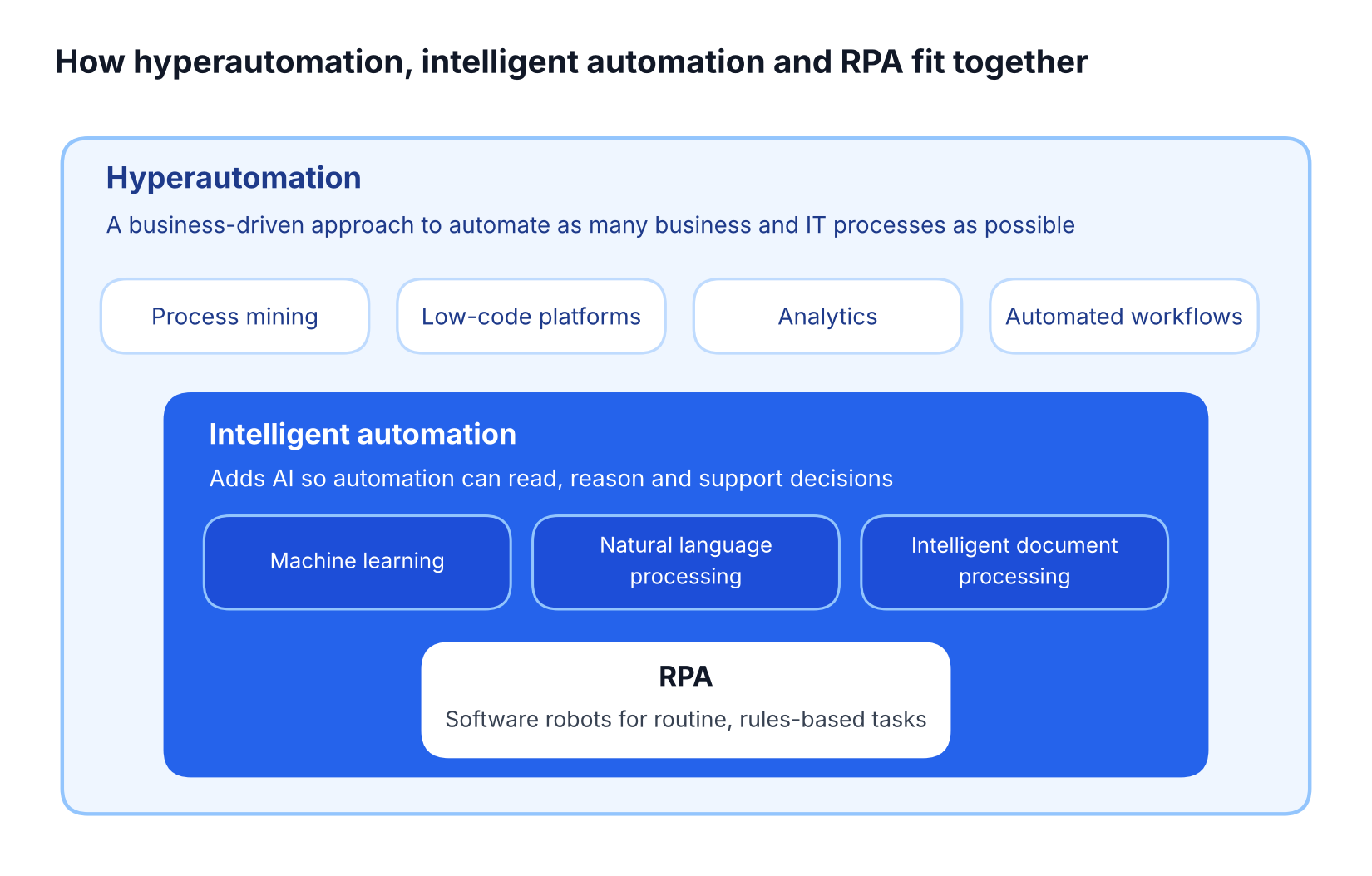
In a nutshell, intelligent automation (IA) combines RPA, AI and machine learning (ML). Hyperautomation is a disciplined, business-driven approach that organizations use to quickly identify, examine and automate as many business and IT processes as possible. As a result, intelligent automation is most often used as part of hyperautomation efforts.
Both use cutting-edge technologies to improve processes. In doing so, they improve the quality of automation results and give customers better interactions.
What Is Intelligent Automation?
Intelligent automation adds AI technologies, such as machine learning, natural language processing and intelligent document processing, to RPA. RPA on its own is not intelligent automation: it automates routine, rules-based processes and simple tasks. Intelligent automation goes a step further and supports people in making decisions.
Because AI can simulate forms of human intelligence, intelligent automation can handle higher-level tasks that require reasoning, judgment, decision-making and analysis.
Why Should Businesses Embrace Hyperautomation?
Intelligent automation has helped many organizations improve their bottom line through more efficient processes. But automating one task at a time has limits, and not every company has the skills to implement RPA effectively on its own. Hyperautomation takes a broader view.
Technologies and concepts included in hyperautomation include:
- Automated workflows
- Machine learning
- Artificial intelligence
- Low-code application platforms
- Robotic process automation (RPA)
- Process mining and analytics
The three main benefits of hyperautomation are increased profits, reduced expenses and stronger compliance.
Hyperautomation uses the same AI models and automation tools as intelligent automation, and adds software such as process mining, low-code and no-code apps, and analytics. It is a more comprehensive approach that can include people in the process.
No one can predict when or how the next business disruption will occur. Preparing your organization for the future means investing to survive and grow, and adapting traditional approaches to your core business and operations. That requires embracing hyperautomation.
Why Hyperautomation Is the Future of Intelligent Automation
Hyperautomation can enable faster deployment of new capabilities without compromising security standards, while ensuring compliance at every step along the way.
With hyperautomation, the future of work is not about having robots perform tasks, but about completely redesigning the work employees do with technology. It increases collaboration so that people, as key decision-makers, can use technology to interpret large amounts of data and apply higher-value insights to their business.
Get Started Today
Don’t wait to give yourself an edge over your competitors. Contact Asignet to learn more about adding hyperautomation to your organization to cut costs and improve efficiency.