Cloud computing has become the standard way to run a business’s technology. However, many organizations are still unaware of the risks and hidden costs that come with managing the cloud. By managing your cloud expenses with automation, you can keep cloud costs under control and save money in the process.
The waste is significant. In Flexera’s 2026 State of the Cloud Report, organizations estimated that 29% of their cloud spend is wasted, a figure that rose for the first time in five years as AI workloads grew. Managing cloud spend is a major challenge for 85% of respondents. Yet many organizations still rely on manual processes to track and pay cloud bills, which leads to late fees, missed savings and higher costs due to a lack of visibility.
What Is Cloud Expense Management?
Cloud expense management is the process of managing and controlling cloud computing costs. Its goals are to optimize billing processes, increase visibility into assets deployed across multiple public clouds, gain greater control over spending, reduce the manual work involved in invoice processing and more.
Why Is Cloud Expense Management Important?
Cloud pricing has become more competitive, but costs remain a challenge for businesses. Cloud bills are based on usage, which changes constantly, so costs can be unpredictable and hard to calculate accurately. Pricing models are also complex, with different rates for compute, storage, data transfer and dozens of other services.
Traditional data centers were a capital expense: you paid for infrastructure up front, before using it. The cloud shifts that to an operating expense you pay as you go. That flexibility is a major advantage, but it also means costs can grow quietly every month if no one is watching, especially when resources are scaled up and never scaled back down.
How to Keep the Cost of Cloud Computing Under Control
Having a clear plan is essential so you can estimate costs accurately and avoid surprises. Start by choosing the right cloud provider and making sure you understand its pricing and support options. Then focus on the levers that make the biggest difference.
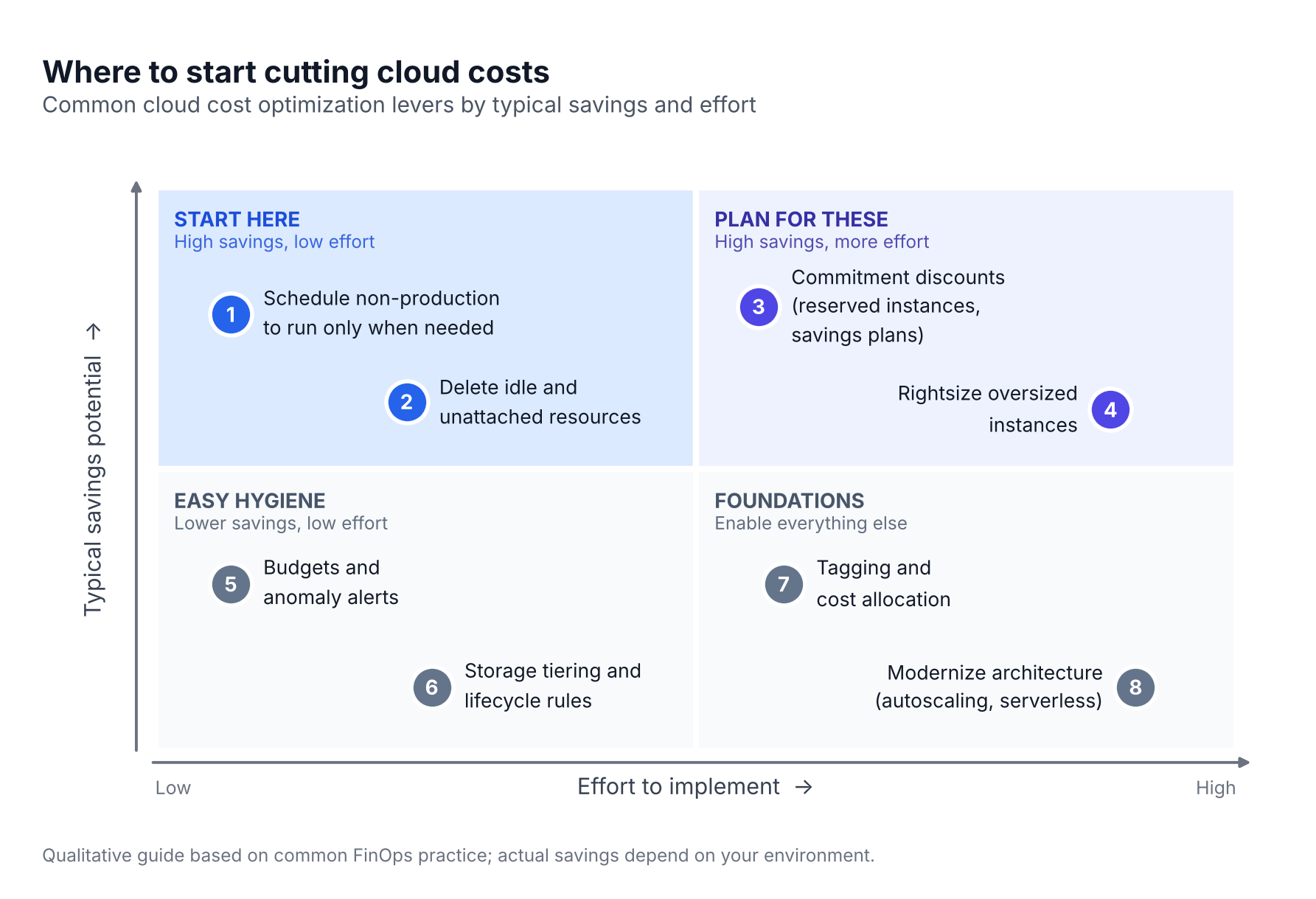
Start Here: High Savings, Low Effort
- 1. Schedule non-production environments. Development and test environments often run around the clock even though they are only used during business hours. Shutting them down at night and on weekends can cut their running time by more than half.
- 2. Delete idle and unattached resources. Unused storage volumes, old snapshots, idle instances and unassigned IP addresses keep billing until someone removes them.
Plan for These: High Savings, More Effort
- 3. Use commitment discounts. Reserved instances, savings plans and committed-use discounts offer lower rates in exchange for a one- or three-year commitment. They require forecasting usage accurately to avoid paying for capacity you don’t use.
- 4. Rightsize oversized instances. Many servers are provisioned larger than they need to be. Matching instance sizes to actual usage reduces costs without affecting performance.
Easy Hygiene: Lower Savings, Low Effort
- 5. Set budgets and anomaly alerts. Alerts catch unexpected spikes, such as a misconfigured service or runaway workload, before they become large bills.
- 6. Use storage tiering and lifecycle rules. Automatically moving older, rarely used data to cheaper storage tiers reduces storage costs over time.
Foundations: Enable Everything Else
- 7. Tag resources and allocate costs. Consistent tagging lets you assign every cloud cost to a project, department or application, so teams can see and own what they spend.
- 8. Modernize your architecture. Autoscaling and serverless services match capacity to demand automatically, so you pay only for what you use.
How Automation Helps
Doing all of this by hand across multiple cloud accounts and providers is difficult. Automation lets you scale resources up or down as needed, so you only pay for what you use, and delivers real-time reporting through dashboards and email alerts.
Machine learning adds another layer. By analyzing billing and usage data, it gives you full visibility into cloud assets, including services used across multiple accounts with different providers, and helps calculate usage costs accurately according to your business needs. That gives you complete insight into your costs, so you can make decisions about projects and departments based on facts instead of gut feeling.
Benefits of Automating Cloud Expense Management
- Cost savings aligned with your business needs.
- Accurate, real-time forecasting of cloud spend, helping you avoid the costs of over- or under-provisioning.
- Usage trend tracking across all your accounts, with monthly and yearly reports for every cloud service you use.
- Better visibility into costs by region and resource, so you can make informed decisions about managing cloud expenses.
- Automated invoice processing through integration with popular accounting systems, making life easier for accountants and managers alike.
- Full control over cloud assets, with up-to-date status for every account, so no asset is left unaccounted for.
Gain Visibility and Control of Your Cloud Spend
The cloud delivers great service at a lower cost than running your own servers. But without clear knowledge of current spending, along with strong security and compliance controls, it’s easy to make mistakes that drive up costs.
A cloud expense management solution helps you track utilization trends and understand where your money goes, so you can make accurate decisions. With complete visibility into the costs of each project and department, you can make informed decisions about how cloud resources are managed and used over time.
Asignet’s Cloud Expense Management solution brings your cloud bills, usage and accounts together in one place, automates invoice validation and cost allocation, and flags waste across providers. Learn more about Cloud Expense Management or talk to Asignet.