
Unified communications as a service (UCaaS) has gone from an option to the default for how enterprises communicate. Instead of running a phone system, a conferencing service, a chat tool and a contact center separately, organizations are bringing them together on one cloud platform. Microsoft alone reported more than 26 million Teams Phone users at the end of 2025, according to Dstny.
Here is what UCaaS is, what it offers enterprises, and how to keep its costs under control once you move.
What Is UCaaS?
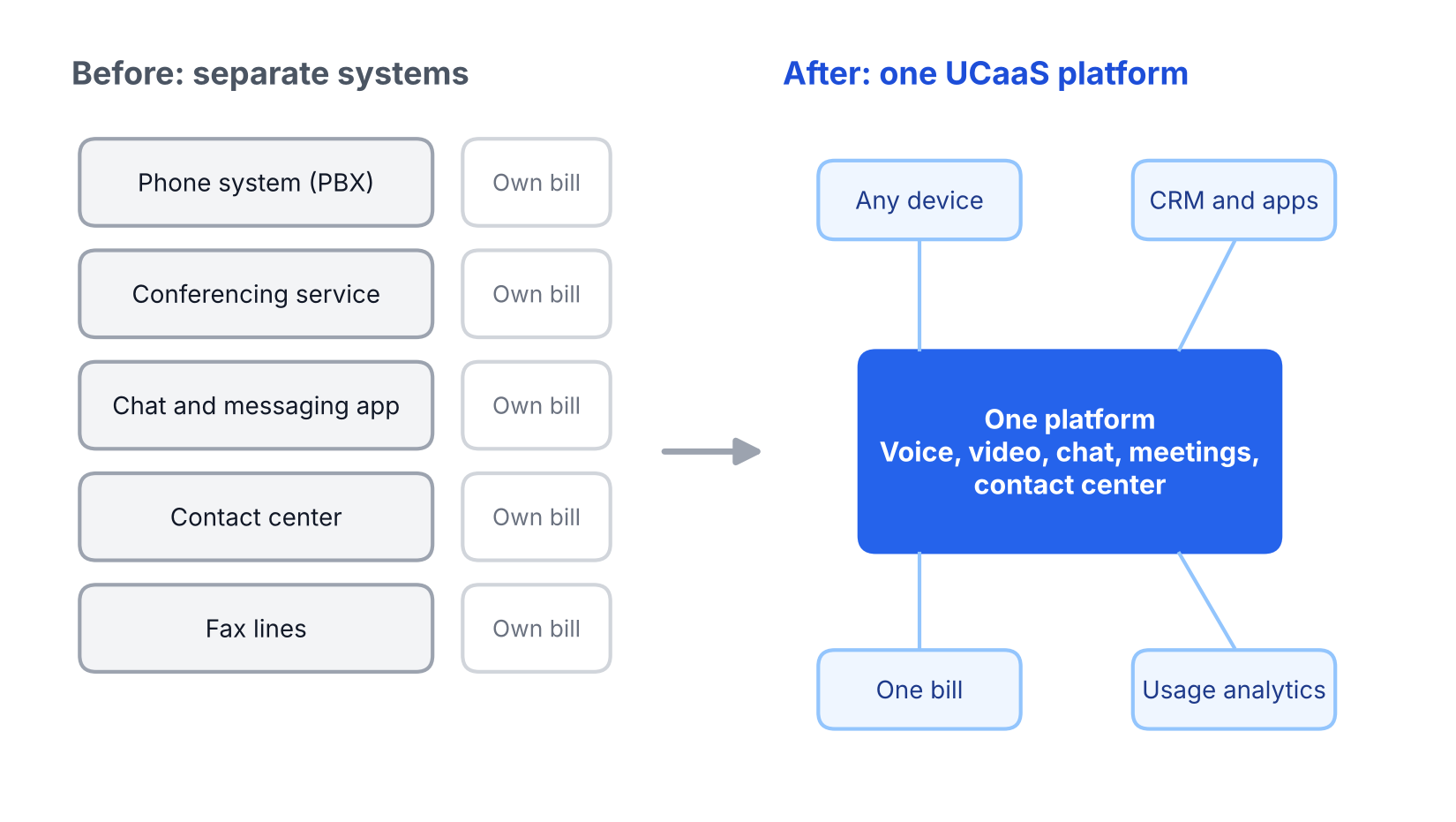
Unified communications (UC) brings voice, video, messaging, meetings and other communication channels together in a single interface. UCaaS is unified communications delivered from the cloud as a subscription service, so there is no on-premises phone system or server hardware to buy and maintain.
UC is not one technology but a connected set of applications. It combines real-time channels, such as calls, video and instant messaging, with asynchronous ones, such as voicemail and email, on any device. Users can move from a chat to a call to a video meeting in the same conversation without switching tools.
Key Features of UCaaS
- Cloud phone system: business phone numbers, calling, voicemail and call routing without an on-premises PBX.
- Video meetings and webinars: scheduled and ad hoc meetings, screen sharing and large online events.
- Team messaging and presence: persistent chat, channels and the ability to see who is available.
- Contact center integration: customer-facing calls and chats handled on the same platform or a connected contact center service.
- Integrations: connections to CRM and other business apps through APIs, so users can see customer details and start a call or message without leaving the app they work in.
- AI features: meeting transcription, summaries, live translation and call analytics are now standard on most major platforms.
Why Enterprises Need UCaaS
- Productivity for hybrid teams: employees can reach each other the same way whether they are in the office, at home or traveling.
- Lower infrastructure costs: no phone hardware to buy, maintain or replace, and less travel thanks to video meetings.
- Scalability: add or remove users and locations in minutes, which matters for growth, seasonal staff and acquisitions.
- Resilience: cloud platforms keep communications running if an office is closed or a site loses power.
- Central management and security: one admin console, consistent security policies and easier compliance across every location.
Microsoft Teams as a UCaaS Platform
For many organizations already on Microsoft 365, Teams is the natural UCaaS platform. Adding Teams Phone turns Teams from a chat and meeting tool into a full business phone system. Organizations can connect it to the public phone network through Microsoft Calling Plans, through a carrier using Operator Connect, or through their own carrier connections with Direct Routing.
Teams is not the only option. Zoom, RingCentral, Cisco Webex and others offer full UCaaS platforms, and many enterprises use more than one. The right choice depends on your existing productivity suite, contact center needs and carrier relationships.
Keep UCaaS Costs Under Control
Moving to UCaaS simplifies communications, but it can create new waste if no one manages the transition and the licenses that follow. Common problems include:
- Overlapping platforms: paying for Teams, Zoom and another calling service when one or two would do.
- Unused licenses: phone and meeting seats still assigned to employees who left or never use them.
- Legacy lines left running: old phone lines, circuits and fax lines that keep billing after the move to the cloud.
- Complex carrier bills: calling plans, usage charges and taxes that are hard to check against contracts.
A complete inventory of lines, licenses and services, matched against invoices and actual usage, is the only reliable way to catch these costs.
How Asignet Helps
Asignet tracks UCaaS licenses, phone lines, circuits and carrier services alongside the rest of your telecom, SaaS and IT spend. Its platform validates every invoice against contracts and inventory, flags unused seats and legacy services, and its managed services team handles disputes with carriers and vendors.
Talk to Asignet about managing your unified communications costs.