Managing technology expenses is hard. Take a minute to imagine the complexity involved in managing just one billing account without RPA and AI. You have to track every move, add and disconnect so you keep an accurate record of your assets, your services and the charges to expect.
Enterprises may also need scripted tasks for moving and rebalancing mailboxes, updating group memberships and permissions, or adding users to certain policies after the HR system provisions their accounts. Today, all of this can be handled in the cloud through robotic process automation (RPA) and artificial intelligence (AI).
The excitement surrounding AI and the technologies it supports has created a great deal of confusion about what these terms really mean and how they differ from one another.
One common misconception is that AI and RPA are interchangeable. Although both technologies are driving major enthusiasm for business process automation, they accomplish tasks in different ways.
How RPA Works
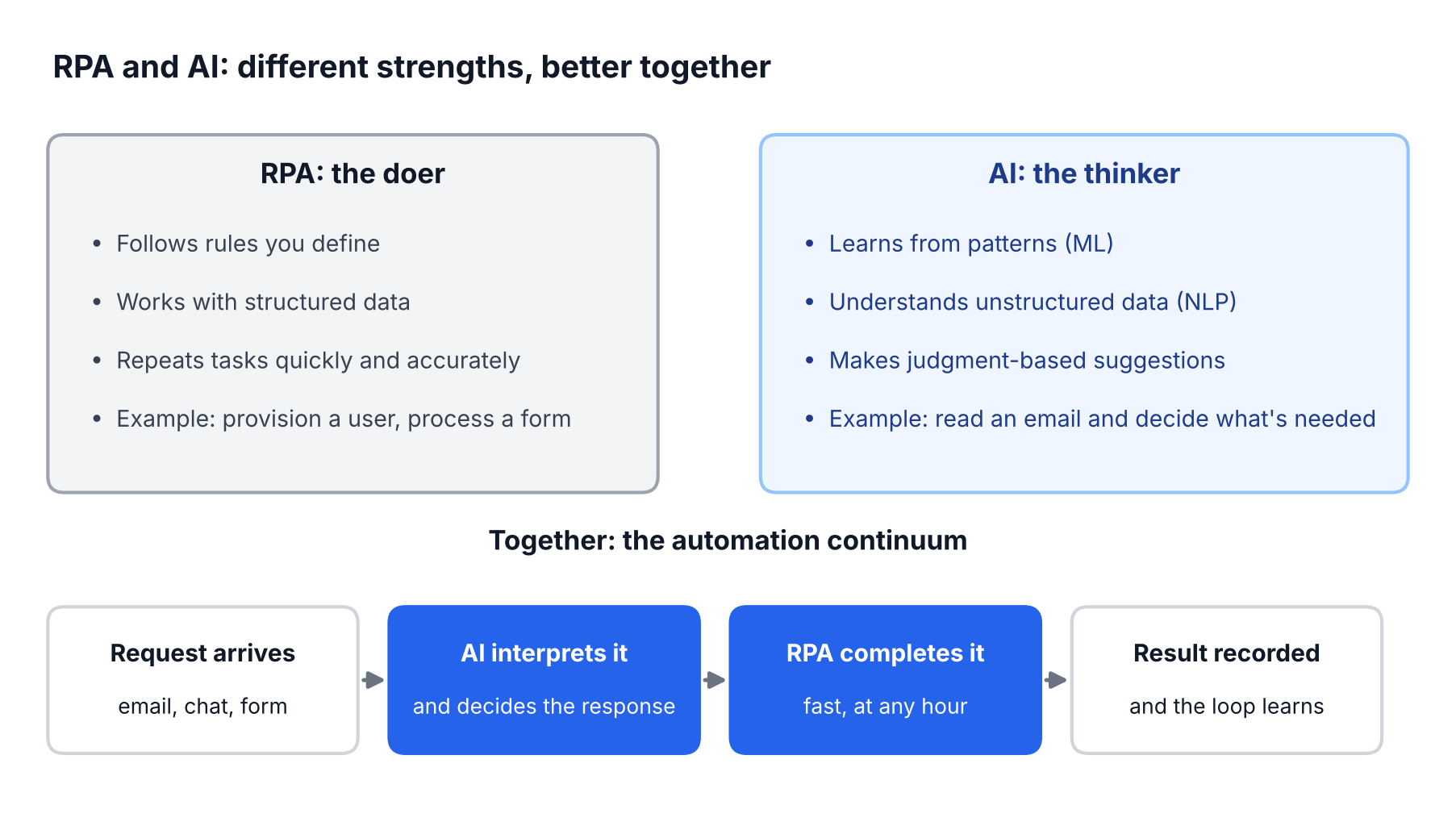
RPA uses software robots to carry out repetitive, rules-based tasks the way a person would, only faster and without errors. Over the past decade it has grown from a niche technology into a multibillion-dollar software category. Gartner estimated worldwide RPA software revenue at $2.9 billion in 2022.
Many of the biggest early investments and most dramatic projects involved large organizations, such as major insurers and government agencies. That has changed as RPA offerings have grown more diverse and sophisticated, and as smaller-scale use cases have demonstrated their economic value.
Asignet enables organizations to extend business process automation to more people, places and devices, delivering workflows for everyone in the company through its cloud integration with Microsoft 365. You can scale and build advanced workflows on a robust platform.
RPA also helps you manage cloud services. It keeps you productive wherever you are by integrating and connecting with a host of cloud services in real time. Enterprises can quickly add web services to workflows without writing a single line of code, and publish forms to collaborate with external vendors, partners and customers.
By integrating enterprise activities with Microsoft 365, business users and IT professionals alike can quickly and easily automate business processes, from simple reviews and approvals to complex integrations across external applications, cloud services, social media and data sources.
A wealth of actions supports everyday processes across industries and departments, including:
- Provisioning
- Help desk
- Leave requests
- Travel requests
- Expense claims
- Maintenance forms
How AI Works
AI is best defined as an umbrella term for a set of technologies that give computers the ability to learn and mimic human thinking, such as judgment-based decisions, reasoning and cognition.
AI includes technologies such as machine learning (ML) and natural language processing (NLP), which let us do more than build rules-based engines to automate repetitive tasks. AI powers voice and facial recognition, voice assistants and data analysis, all of which capture data that can be used to trigger a judgment-based response.
Cognitive reasoning engines apply the data captured from learned patterns to make business and operational suggestions. AI’s ability to aggregate, manage and understand unstructured data is what sets it apart from RPA.
RPA and AI Together: The Automation Continuum
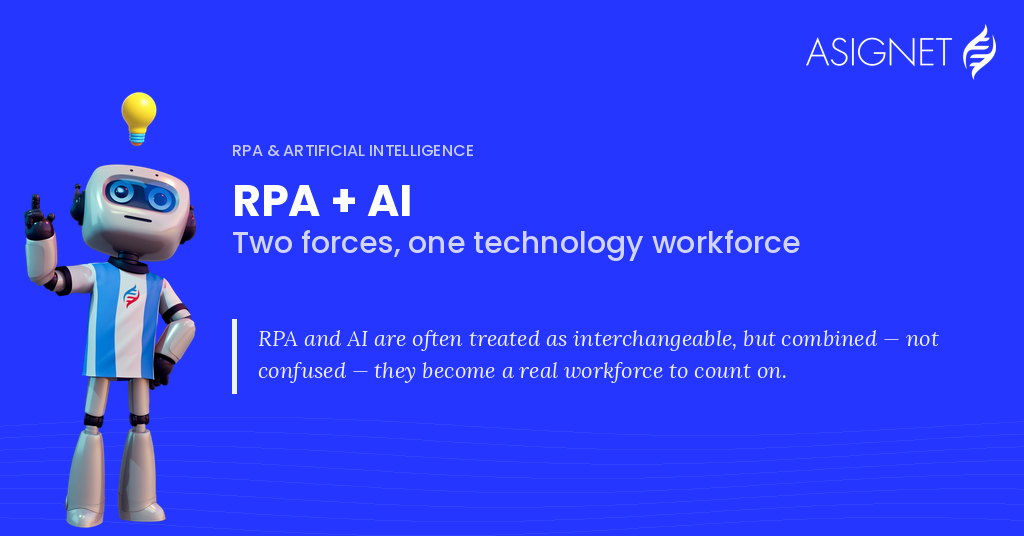
Both are great tools for business process automation, and together they form a workforce you can count on. When the two are integrated, automation starts faster and becomes a continuum.
In this continuum, AI produces an accurate cognitive response and passes it directly to the RPA system, which completes the task even faster. In practice, this can be as simple as reducing the wait time for a customer inquiry submitted outside business hours.
Years ago, RPA was described as something that would develop dramatically in the future. That future is here. For most companies looking to reduce costs and increase productivity, combining RPA and AI is the way forward.
Contact Asignet to learn more about our solutions.