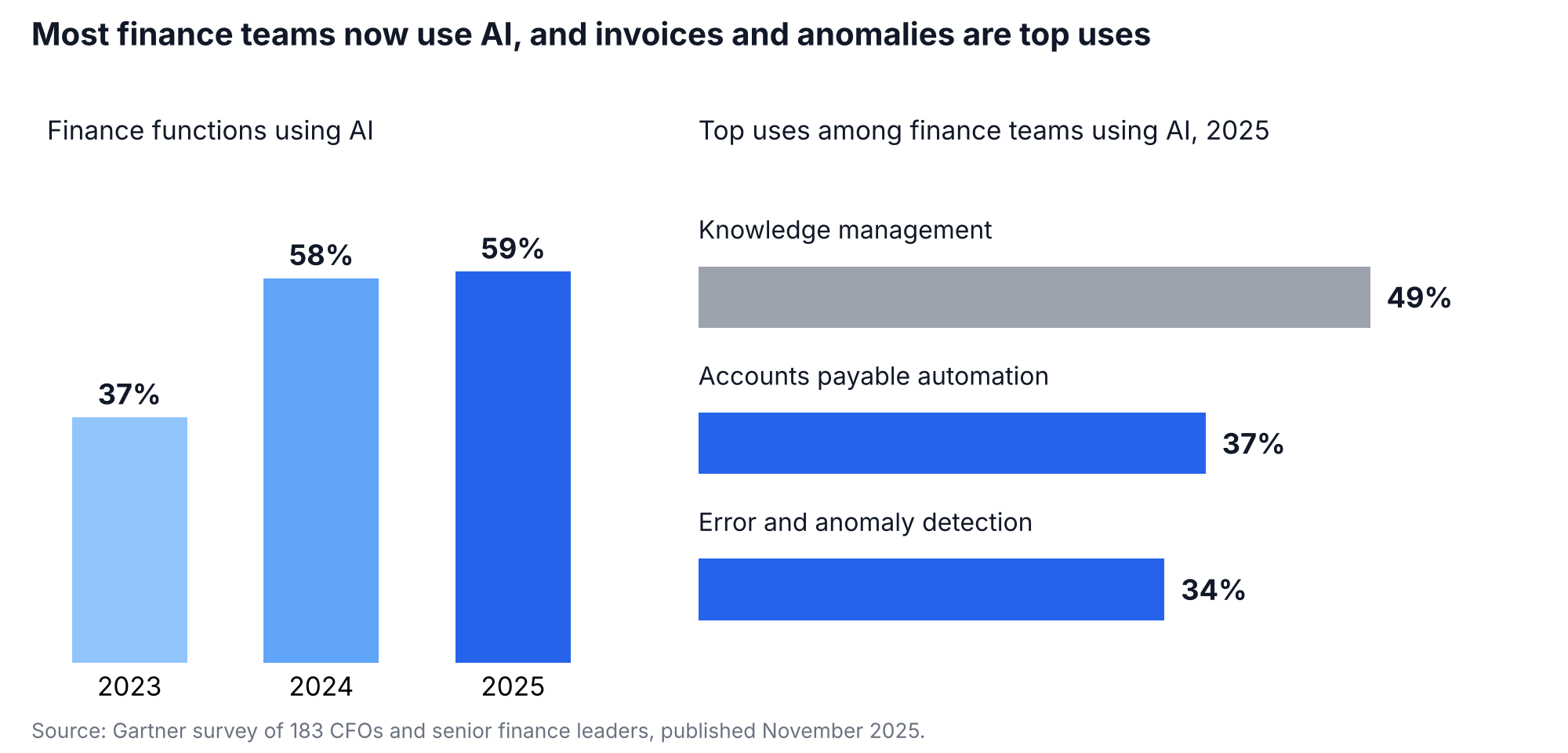
AI is no longer an experiment for most finance and IT teams. In a 2025 Gartner survey, 59% of finance leaders said they use AI in their finance function, up from 37% in 2023. The harder question is no longer whether to use AI, but where it actually pays off.
The answer is problems that are high-volume, data-heavy and too complex to handle well by hand. IT expense management is full of them. Thousands of invoices in different formats, constantly changing contracts, SaaS licenses and cloud resources that scale up and down every month: these are exactly the problems that demand AI solutions.
What Makes a Problem Right for AI?
Not every problem needs AI. The best candidates share a few traits:
- High volume and repetition: the same task happens thousands of times, such as reading and coding invoices.
- Messy, inconsistent data: information arrives in many formats from many vendors, and rules-based tools break when the format changes.
- Patterns people miss: errors, overcharges and waste hide in large data sets where manual review only samples a fraction.
- Clear rules and measurable results: there is a contract, a rate or a policy to check against, and savings can be counted.
Six IT Expense Problems That Demand AI
1. Invoices in Every Format
Telecom carriers, cloud providers, SaaS vendors and hardware suppliers all bill differently, and many still send PDFs or paper. Template-based tools need constant maintenance. AI-powered parsing reads invoices in any format, extracts every charge and standardizes the data without a template for each vendor.
2. Billing Errors and Contract Drift
Rates change, discounts expire and services keep billing after they are disconnected. AI-based anomaly detection compares every charge against contract terms and past bills, and flags variances in real time instead of months later in an audit. Error and anomaly detection is already one of the top uses of AI in finance, cited by 34% of finance teams using AI.
3. SaaS License Waste
The average organization uses only 54% of its SaaS licenses, wasting $19.8 million a year on the rest (Zylo 2026 SaaS Management Index). AI can match license assignments against actual login and usage data, identify inactive users and recommend which seats to reclaim before renewal.
4. Cloud and AI Consumption
Organizations estimate that 29% of their cloud spend is wasted, and that number rose in 2026 for the first time in five years as AI workloads grew (Flexera 2026 State of the Cloud Report). Usage-based billing changes by the hour, so AI is needed to spot idle resources, unusual spikes and commitments that no longer match usage.
5. Mobile Devices and Plans
Large organizations manage thousands of mobile lines, each with its own plan, device and usage pattern. AI can detect lines with no activity, devices assigned to departed employees and plans that no longer fit usage, and recommend changes at scale.
6. Cost Allocation and Inventory Reconciliation
Charging costs to the right department or project means matching every invoice line to an asset, a user and a cost center. When inventory and billing live in separate systems, this takes days of manual reconciliation each month. AI can match records across systems automatically and flag the exceptions that need a person’s attention.
How to Get Started
The organizations that get value from AI tend to follow the same sequence:
- Pick the right problem: start with an urgent, high-volume problem where savings are measurable, such as invoice validation or license reclamation.
- Check your data: identify the invoices, contracts, inventory and usage data the use case needs, and how clean it is. Gartner finds data quality and skills are the biggest barriers to AI in finance.
- Decide how to staff it: build in-house, partner with a provider, or use a managed service that brings both the technology and the expertise.
- Start small and measure: run a pilot on one category of spend, measure the savings and accuracy, then scale.
- Keep people in the loop: use AI to handle volume and surface exceptions, and let your team make the decisions that need judgment.
How Asignet Applies AI to IT Expense Management
Asignet uses AI-powered parsers to read invoices and asset records from any vendor, and a real-time AI audit engine that checks every transaction against contracts and inventory. The platform covers telecom, mobility, SaaS, cloud and IT spend in one place, and Asignet’s managed services team handles the disputes, vendor interactions and exceptions the automation surfaces.
Talk to Asignet about where AI can reduce your technology spend.