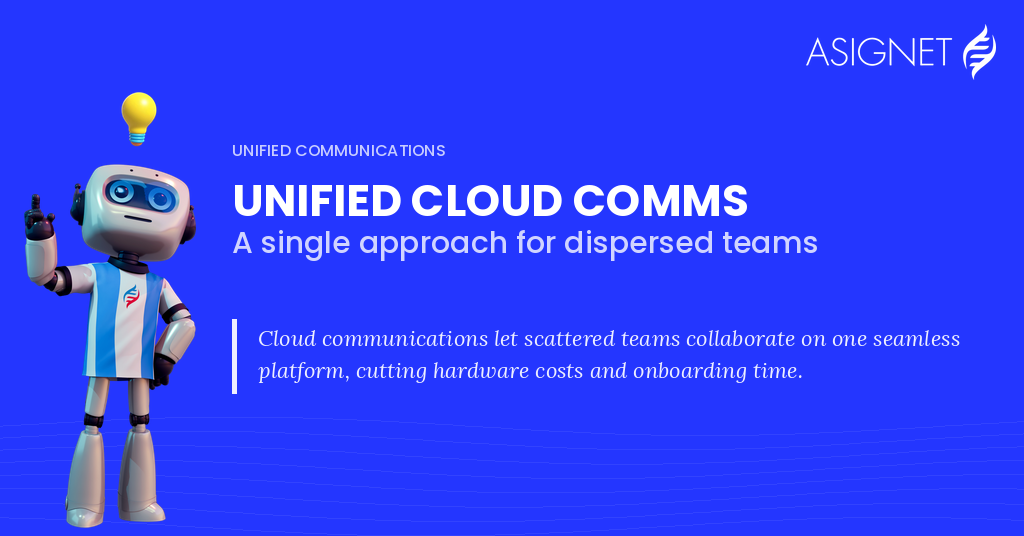
Cloud communication has grown in popularity for many reasons, and the shift to hybrid and remote work has only accelerated it. It can offer improvements across several functional areas of a company, especially for small and midsize businesses (SMBs).
When you opt for a unified approach, you are choosing a seamless method of communication that links your staff, clients and partners together in an easy-to-use platform and helps maintain a professional business identity.
Putting your unified communications (UC) in the cloud, known as unified communications as a service (UCaaS), offers a variety of advantages for almost any business. More than ever, companies are looking for innovative ways to help dispersed groups and teams communicate with one another.
Benefits of Moving Unified Communications to the Cloud
Some of the benefits you get when you move to the cloud include the following.
1. Scalability
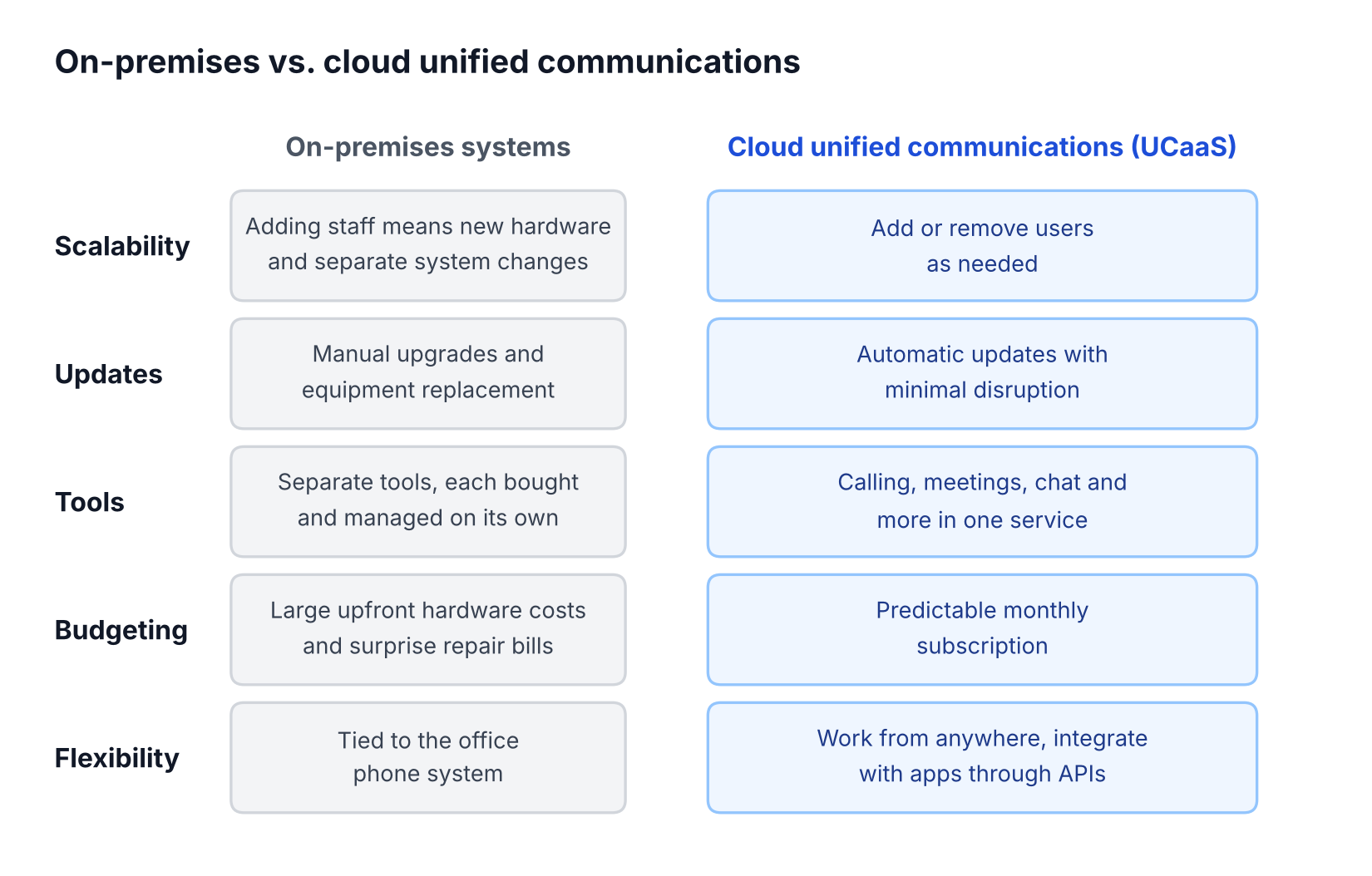
Cloud communications make it easier to scale with your business needs. Adding and removing employees can be a hassle with in-house systems, especially if all of your communication methods are independent of each other. With UC, you can add or remove staff members as needed.
This scalability can reduce the time it takes to onboard a new employee, and it is especially useful for businesses that are growing quickly or have seasonal spikes in staffing, such as retailers and tax firms.
UC also reduces the money you need to spend on extra hardware to support these employees, and it can eliminate stacks of servers that take up valuable space.
2. Cutting-Edge Solutions
In the technology world, things change fast. Just think about how much your business operations have evolved in the past five years.
Consider how many new tools you have added and how you have adapted to an evolving media landscape. With cloud communications, you stay up to date with automatic updates to both hardware and software, usually with minimal disruption to your workflow.
3. More Resources for SMBs
The tools that come with UCaaS would add up significantly if you bought them individually from separate providers. In addition to these features, SMBs also benefit from a flexible and seamless experience.
Without UCaaS, navigating multiple communication tools can be clunky and frustrating, especially without a robust IT team to keep things running smoothly.
4. Ease of Budgeting
One of the primary benefits of unified cloud communications for SMBs is reducing capital expenses. Extensive hardware can be a steep cost for SMBs.
By replacing these costs with a UCaaS subscription, SMBs can minimize upfront expenses, making the move to the cloud more manageable.
The predictable pricing model of cloud services also helps. You don’t suddenly need to pay hundreds or thousands of dollars for new hardware if your on-site equipment fails.
5. Flexibility
We’ve mentioned the ability to add and remove people as needed, but UCaaS also offers flexibility in a few other ways.
You can often integrate UCaaS tools with applications you already use through APIs. This lets employees use your UCaaS features alongside the other programs they work in, simplifying their work and streamlining processes.
UCaaS also gives employees mobility. They may need to work from home for a variety of reasons, such as a sick child, recovery from an injury or a hybrid work schedule. A cloud communication platform makes it easy for them to access everything they need from home. Most features are web-based, so as long as they have an internet connection, they can do their jobs.
Phone calls and mobile device use also become more manageable. Employees can make calls that display their business numbers and reach colleagues through their extensions rather than memorizing phone numbers. UCaaS can also support a bring-your-own-device (BYOD) policy that keeps data safe while giving employees a wide range of access options.
Cloud service providers can also take care of many IT needs, which saves on support and maintenance, staffing, and software and hardware updates.
Benefits Asignet Can Bring to Your Company
With RPA a native part of its Wayfast platform, Asignet has built robotic process automation into its architecture and processes. This provides the flexibility, integration and configuration needed to collect, process, analyze, act on and report on any data point, from any platform, in any format, and present it all in a single holistic management view.
Today, Asignet has built and deployed thousands of automated workflows that execute a wide variety of actions for clients in all verticals globally. Its ability to go deep into IT asset management (ITAM), cloud, traditional fixed services, and all mobility services and devices lets Asignet address specific client requirements in a highly customized way.
Talk to Asignet about managing your cloud communications and the costs that come with them.