What Is Robotic Process Automation (RPA)?
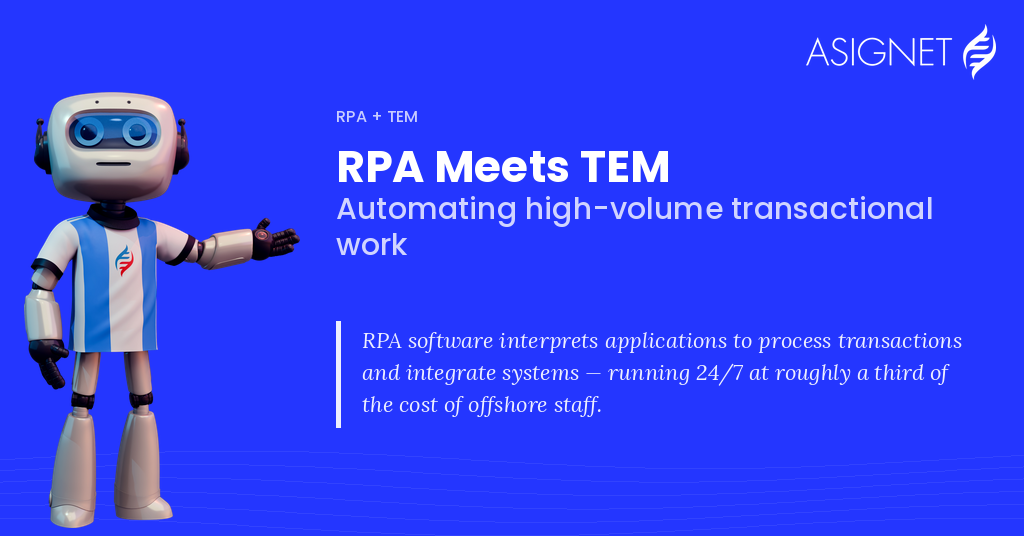
Robotic process automation (RPA) is an application of technology that allows computer software, or a “robot,” to work with existing applications, with or without a service-oriented architecture (SOA), to process transactions, manipulate data, trigger responses and communicate with other digital systems.
RPA is one of the most exciting developments in business process management (BPM) in recent history. Some industry experts have argued it could be even more transformational than cloud computing.
But is this game-changing technology really new? In its current form, yes, but its roots can be traced back to macros that automate a sequence of keystrokes or mouse actions. Macros typically replace a repetitive series of keyboard and mouse actions and are common in spreadsheet and word processing applications such as Microsoft Excel and Microsoft Word.
What is different about today’s RPA is the maturity of both the technology and the business processes it is applied to.
Key Drivers Behind RPA
The RPA market has advanced rapidly, and widespread adoption is reshaping the BPM marketplace. These are the key drivers behind that transformation:
- Cost reduction: software robots typically cost far less than the staff time needed to perform the same tasks manually.
- Efficiency: RPA can run 24/7 without breaks, as long as the underlying core applications are available.
- Accuracy: people make data entry mistakes, while robots perform the same task the same way every time, as long as no judgment call is required.
- Audit and regulatory compliance: robots provide detailed audit logs that enable advanced business analytics and improved compliance.
- Easier change management: robots preserve application and data integrity by working through the existing application interface and reusing existing application logic, databases and validation, without deep re-engineering.
They say there’s nothing as powerful as an idea whose time has come. The time for RPA-powered transformation is now.
How RPA Connects to Telecom Expense Management
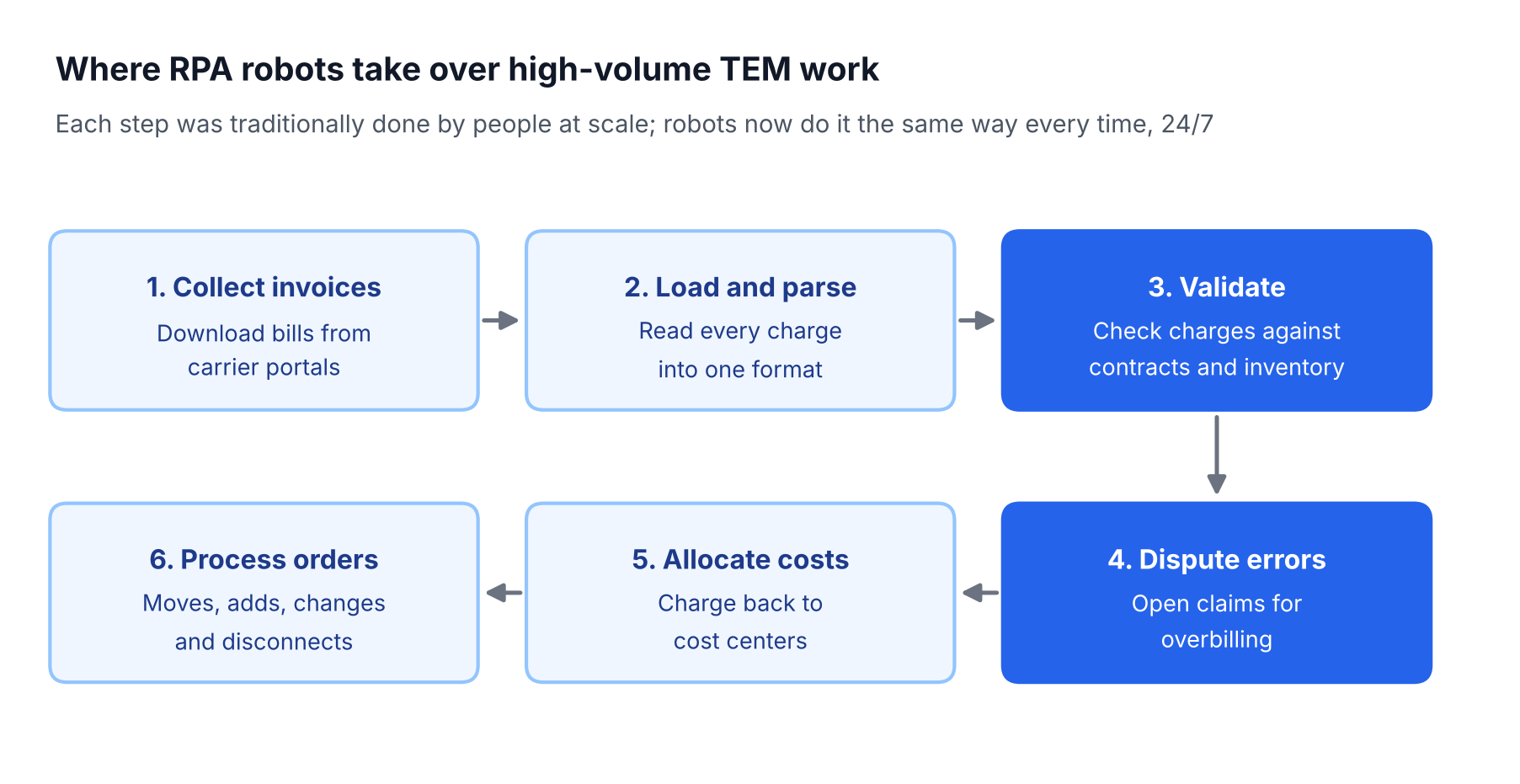
The connection is this: telecom expense management (TEM) relies on labor at large scale for general knowledge work, with people performing high-volume, highly transactional processes. Just as industrial robots remade manufacturing with higher production rates and better quality, RPA robots are changing the way we think about and run business processes, IT support processes, workflows, remote infrastructure and integration.
RPA delivers dramatic improvements in accuracy, cycle time and transaction-processing productivity, while elevating the nature of work by removing people from dull, repetitive tasks. This is where RPA connects to TEM in a big way.
TEM and Newer Network Technologies Like SD-WAN
TEM technology and teams need to be able to manage newer technologies as they arrive. As cloud services have grown, software-defined wide area networking (SD-WAN) has become one of the technologies the TEM industry must manage and integrate.
The concepts of billing and provisioning stay the same, but managing SD-WAN takes advanced expense management technology and knowledgeable, network-focused staff.
SD-WAN can remove potentially expensive routing hardware by provisioning connectivity and services through the cloud. It is also more flexible: because SD-WAN connectivity is controlled through cloud software, customers can scale up, or “burst,” connectivity during periods of peak demand.
Contact Asignet to learn more about our RPA solutions for telecom expense management.