A Few Takeaways First:
- RPA ≠ AI; AI can complement RPA.
- Automate stable, repetitive processes—not broken ones.
- Invoice validation is a strong RPA use case.
- Measure actual ROI and plan for bot maintenance.
What is Robotic Process Automation (RPA)?
Robotic Process Automation uses software “bots” to handle repetitive, rule-based data tasks like pulling carrier invoices, validating asset inventories, and updating billing systems automatically without human intervention. That’s the simple way of putting it, but this definition sells RPA short.
Enterprise software talks to other enterprise software in two ways:
- Through an API — the clean way, which involves a documented, stable contract where System A asks System B for data and System B answers in a predictable format.
- Through a user interface — the messy way, which involves all of the screens, fields, and buttons a human clicks when performing the same task.
RPA works at the second layer.
What RPA actually is:
An RPA bot is a program that drives the user interface: it opens the carrier portal, types the credentials, navigates to the billing tab, selects last month, downloads the PDF, opens the ERP, finds the matching purchase order, and compares the two. Every step is one a person could do, and every step is specified in advance.
RPA’s superpower:
RPA does not require the target system to cooperate. A twenty-year-old billing platform with no API, a carrier portal you do not control, a vendor system your team will never be granted database access to… RPA can work with all of them, because it needs nothing more than the access a human employee already has. For organizations whose costs are trapped inside dozens of external vendor portals, Robotic Process Automation can lower costs significantly, while solving many headaches.
RPA’s greatest weakness:
Interfaces change. When a vendor moves a button, the bot that depended on that button’s position fails.
What RPA is not
RPA is not AI.
Classical RPA follows rules. It does not learn, infer, or generalize. Given an input it has not seen, it does not improvise — it stops. Modern platforms bolt intelligence onto the front end (document understanding to read an unstructured invoice) or the back end (a model to decide which exception queue an anomaly belongs in), but the automation core remains deterministic. That determinism is a feature in any process that must be audited.
RPA is not workflow automation.
A workflow tool routes a task between people according to a process map. RPA performs the task. They are complements, and the strongest deployments use both.
RPA is not integration.
RPA works on the front end by mimicking human actions like clicking and typing on a screen. An integration (usually via API) connects systems on the back end for direct, structured data sharing. If a clean API exists and you control both endpoints, use the API.
The process of rolling out RPA bots.
The lifecycle below is what a competent RPA deployment looks like in practice. It is why Asignet offers RPA “as a service” instead of “software,” or even software as a service (SaaS). Robotic Process Automation as a service (RPAaaS) is about more than setting up a few rules.
Step 1: Observe and document.
Someone watches the process being performed and records every decision point, including the ones the operator makes unconsciously. This is the step organizations most often shortchange, but it’s the step that most determines outcomes.
Step 2: Rationalize before you automate.
The process is redesigned before it is encoded. Automating a broken process produces a faster broken process. If three of the eleven steps exist only because of a system limitation that no longer applies with RPA, they should be deleted, not automated.
Step 3: Build.
The rules are encoded by developers or, increasingly, through low-code visual builders that let the person who owns the process configure it directly.
Step 4: Test against reality.
The malformed PDF, the vendor who changed their invoice template, the timeout at 3 a.m., the credit note that arrives before the invoice it credits… You can’t catch everything, but the more you test the better.
Step 5: Deploy with governance.
The bot needs to have credentials managed like any privileged account, including an audit trail, and a defined escalation path when it fails. For most intents and purposes, consider it an employee with regard to account access, and only grant the access needed to perform the specific task/s. No more, no less.
Step 6: Monitor and maintain.
All too often, this is where budgets go to die. Bots will break. The question is whether that breakage is detected within in minutes by monitoring, or if it takes weeks before an angry vendor brings it to your attention. A true RPA service will continuously monitor the processes from start to finish, and quickly identify any breaking points.
Attended RPA, unattended RPA, and the hybrid middle
| Mode | Trigger | Best suited to | Trade-off |
|---|---|---|---|
| Attended | A person starts it, at their desk | Customer-facing work, exception handling, judgment-heavy steps | Throughput is capped by the human |
| Unattended | A schedule or system event, on a server | High-volume back-office work: invoice retrieval, reconciliation, reporting | Requires real governance and monitoring |
| Hybrid | Bot runs unattended, escalates to a person on exception | Most finance and IT processes worth automating | More design effort up front |
Hybrid RPA is the right answer for nearly all invoice and expense work. You do not want a bot silently approving a charge it does not understand, and you do not want a person manually retrieving 4,000 invoices. Instead, you want the bot to handle the invoices that match cleanly, and route the rest to someone with authority to judge. This is exactly the model behind Asignet’s invoice validation, where robots retrieve and validate, while a managed services team takes the disputes and vendor negotiations.
RPA versus everything it gets confused with
| Technology | What it does | Deterministic? | Use it when |
|---|---|---|---|
| RPA | Operates existing UIs by explicit rules | Yes | No API exists, or you don’t control the system |
| API integration | Systems exchange data directly | Yes | A stable API exists and you control both ends |
| IDP (intelligent document processing) | Extracts structured data from unstructured documents | Partly | Inputs are PDFs, scans, or varied invoice formats |
| Process mining | Discovers how a process actually runs from system logs | Yes | You need to find what to automate |
| Workflow / BPM | Routes tasks between people and systems | Yes | The bottleneck is coordination, not execution |
| AI agents | Pursue a goal, choosing their own steps | No | The path can’t be specified in advance |
| Hyperautomation | The orchestration of all of the above | — | You’re building a program, not a project |
Why do you need an RPA solution?
The time argument
Hours disappear into retrieving invoices from portals, keying line items into spreadsheets, and reconciling charges against contracts that live in a different system entirely. None of that work is analysis. It is the the work an analyst has to do before analysis can begin. The point of automating this work is not to eliminate the human expert, but to move them from assembling the data to analyzing and acting on it.
The error argument
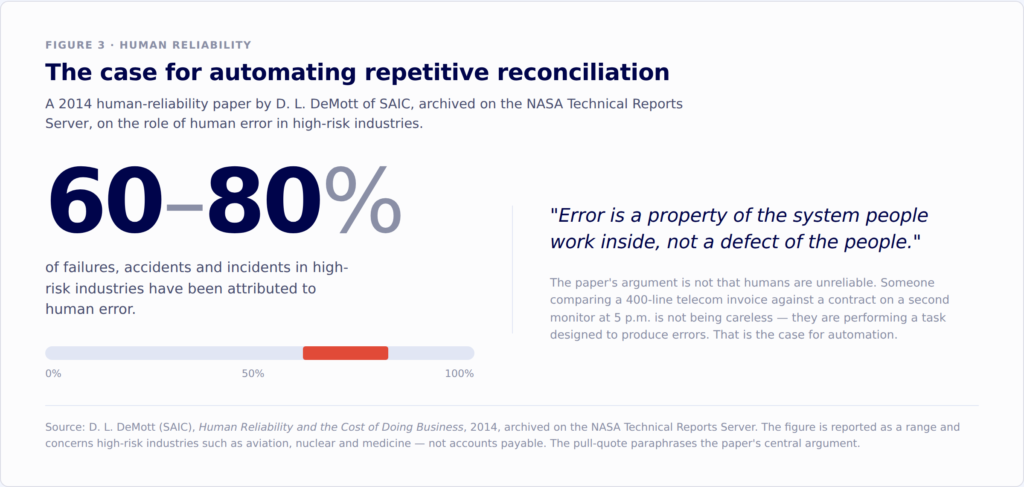
“Human error has been reported as being responsible for 60%–80% of failures, accidents and incidents in high-risk industries.”
D. L. DeMott, Human Reliability and the Cost of Doing Business, 2014, archived on the NASA Technical Reports Server
DeMott’s central argument is not that humans are unreliable but that error is a property of the system people work inside, not a defect of the people. Someone comparing a 400-line telecom invoice against a contract on a second monitor at 5 p.m. is not being careless. They are performing a task designed to produce errors.
That is the correct case for automation. Not that people are the problem, but that repetitive, high-volume reconciliation is a badly designed job, and machines are better at the parts of it that punish attention lapses.
The scope argument
In practice, once a bot can operate a portal and read a document, the same capability extends across an entire category of spend:
- Mobile inventory and user assignment — devices, plans, and who actually has what, reconciled continuously rather than annually (mobile expense management)
- Invoice retrieval, validation, chargeback and dispute — the core of invoice validation
- IT asset discovery — routers, gateways, operating systems, software licenses, servers, collected into a single inventory across the technology lifecycle
- SaaS and cloud commitments — licenses and consumption reconciled against what was bought (SaaS management, cloud expense management)
- Telecom and UCaaS contract compliance — every line checked against what was actually negotiated (TEM, unified communications)
Why RPA programs stall or fail
Avoiding these failure modes if you want to run a successful RPA program.
Most programs never reach scale.
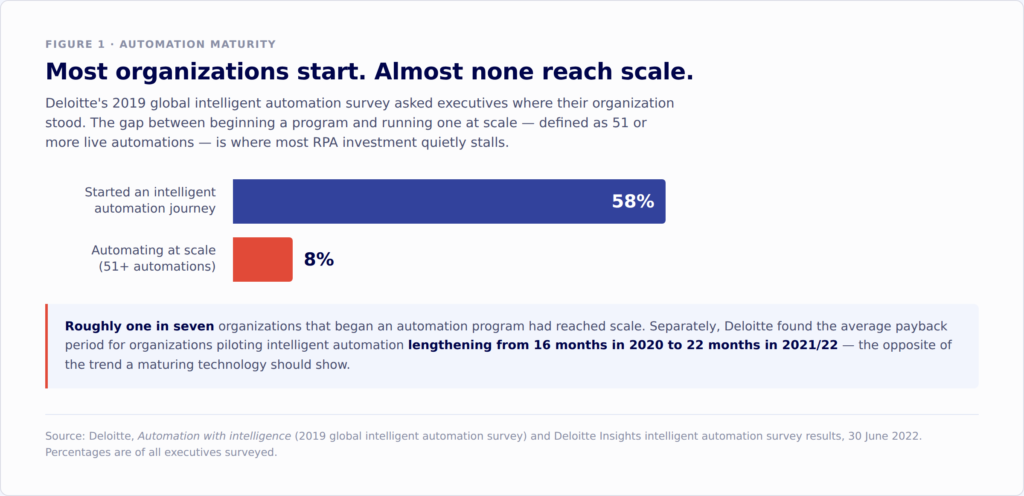
Deloitte’s 2019 global intelligent automation survey found that while 58% of executives said their organization had started an intelligent automation journey, only 8% were automating at scale — defined as 51 or more live automations. That 8% was double the prior year’s figure, which tells you both that the direction is right and that the base is very low. (Deloitte, Automation with intelligence)
Bots break, constantly.
A Forrester Consulting study commissioned by Tricentis found that 45% of firms deal with bot breakage on a weekly basis or more often, that 99% of respondents said their bot logic required some scripting — averaging 42% of total bot logic — and that 79% reported their RPA programs required advanced programming skills. (Forrester Consulting, RPA Reality Check, 2020)
That last pair of numbers deserves emphasis, because it is the gap between how RPA is sold and how it is delivered. “No coding required” is a claim about the demo. The Forrester data is a measurement of the actual production.
Reported savings are often estimated, not measured.
In 2023 the U.S. General Services Administration’s Office of Inspector General audited GSA’s own RPA program, which had publicly claimed to reclaim more than 240,000 work hours per year. The IG found the claim “inaccurate and unreliable.” Auditors sampled ten bots representing about 45% of the claimed savings and found GSA was not verifying actual hours saved with the people using the bots; one bot credited with 3,650 hours of savings was used by people who reported no time savings at all; and two bots credited with a combined 15,000 annual hours had been retired after four months. (GSA OIG, Report A210057, 30 Nov 2023) Insist on measurement against a pre-automation baseline.
Payback is getting longer, not shorter. Deloitte’s later survey wave found the average payback period for organizations piloting intelligent automation lengthening from 16 months in 2020 to 22 months in 2021/22, even as expected three-year cost reduction rose to 31%. More than half of respondents had not calculated cost reduction at all, and 70% had not calculated revenue increase. (Deloitte Insights, 30 June 2022)
The barriers are organizational, not technical. Asked what blocked scaling, executives cited difficulty integrating various solutions (62%), lack of skills and experience (55%), and inability to change business processes or ways of working (52%). Process fragmentation was the top barrier across four consecutive annual surveys. (Same source.)
And the widely quoted failure rate is real but old. The frequently repeated claim that 30–50% of RPA projects fail traces to a single 2016 EY paper, where the actual wording was: “we have seen as many as 30 to 50% of initial RPA projects fail. This isn’t a reflection of the technology; there are many successful deployments.” (EY, Get ready for robots, 2016) It is a practitioner observation, not a survey. There was no sample size, no definition of failure, and it is now a decade old. Yet, the failure rate contineus to get quoted as though it were current research. It is not, and you should discount anyone who presents it that way.
What separates the programs that compound
Programs that scale share a small number of habits.
They select processes deliberately. The single highest-leverage decision in an RPA program is choosing what to automate first. A process is a good candidate when it is high-volume, rules-based, stable, digital in its inputs, and consequential when it goes wrong. It is a poor candidate when it is rare, judgment-heavy, or currently undergoing redesign.
A usable screen, in the order the questions actually matter:
| Question | Automate | Don’t |
|---|---|---|
| How often does it run? | Daily or more | A few times a year |
| Can the rules be written down completely? | Yes, exhaustively | “It depends” |
| How stable are the source systems? | Stable, or changes are announced | Constantly shifting |
| Are inputs digital? | Yes, or IDP can read them | Handwritten, verbal |
| What does an error cost? | Real money or compliance risk | Negligible |
| Is the process being redesigned? | No | Yes — wait, then automate |
They centralize expertise. The same Forrester study found that only about one in five firms had a centralized automation Center of Excellence — and that firms with one showed 3.5 times more automation. Leaders also held custom scripting to an 11.4% weighted average of bot logic, versus a 45.9% weighted average for everyone else. Less bespoke code, more reuse, more scale.
They lower the build barrier. The scripting numbers above are the practical case for low-code. When only a small central team can build or repair a bot, the backlog becomes the constraint and every vendor portal change becomes a ticket. When the person who owns the process can adjust the automation themselves, maintenance stops being a bottleneck. This is the thinking behind Asignet’s Wayfast low-code environment, which lets teams compose workflows and integrations with close to zero hand-written code, and behind its parser automation tool, which maps a new invoice format — in any layout, from any vendor — without a developer writing a template.
They measure against a baseline. Capture cycle time, error rate, and cost per transaction before the bot goes live, and re-measure after. Self-reported hours saved are not evidence.
They plan for maintenance from day one. Budget it, staff it, monitor it. A bot with no owner is a future outage.
RPA and AI agents: what changed in 2026
This is where most current RPA content is least useful, because it is either “RPA is dead, agents replace everything” or a refusal to engage. The published analyst positions are more interesting than either.
Gartner’s warning is about vendors, not the technology. In June 2025 Gartner predicted that over 40% of agentic AI projects will be canceled by the end of 2027. Senior Director Analyst Anushree Verma: “Many vendors are contributing to the hype by engaging in ‘agent washing’ – the rebranding of existing products, such as AI assistants, robotic process automation (RPA) and chatbots, without substantial agentic capabilities.” Gartner estimated that of the thousands of vendors claiming agentic capability, only about 130 are real. (Gartner, 25 June 2025)
Read that carefully if you are running a vendor evaluation. It means a meaningful share of “AI agent” pitches you will hear are RPA with new labels — which is not disqualifying, but should be priced and governed as RPA, as opposed to “AI”.
Forrester expects deterministic automation to hold the floor. In its blog summary of Predictions 2026: Automation And Robotics, Forrester forecast that fewer than 15% of firms will turn on the agentic features in intelligent automation suites, and described 2026 as the year buyers try to align deterministic and cognitive automation into a common framework — an emerging “automation fabric.” (Forrester, Predictions 2026: Automation At The Crossroads)
Adoption is running far ahead of production. Forrester reported in June 2026 that around three-quarters of enterprise leaders say they are adopting agentic AI, while only a small minority have meaningful production deployment beyond basic chatbots — and that 49% of security decision-makers named agentic AI as a concern. (Forrester, 3 June 2026)
And headcount reduction is not the ROI story. Gartner surveyed 350 executives at $1B+ enterprises that had piloted or deployed AI agents, intelligent automation, or autonomous technologies. Roughly 80% reported workforce reductions — but those reductions “do not appear to translate into return on investment,” with near-identical reduction rates among high-ROI and low-ROI organizations. Distinguished VP Analyst Helen Poitevin: “Many CEOs turn to layoffs to demonstrate quick AI returns; however, this disposition is misplaced.” (Gartner, 5 May 2026)
The practical synthesis
Determinism is not a limitation to be outgrown. It is a requirement in any process that has to be defended to an auditor, a regulator, or a vendor’s billing department. You want a rule deciding whether a charge matches a contract, because you will need to show your work.
Where probabilistic AI genuinely helps is at the edges of the deterministic core: reading a document layout nobody has seen before, classifying an anomaly, drafting a dispute letter, spotting a pattern across 40,000 line items that no rule anticipated. The sensible 2026 architecture is a rules-based engine handling execution and adjudication, with AI on the perception and exception-handling boundary.
Where this pays off first: invoice and IT spend validation
If you automate one thing, automate the validation of what you are being billed. The processes are high-volume, rules-based, and expensive to get wrong. This is a textbook match for RPA.
What the benchmarks say
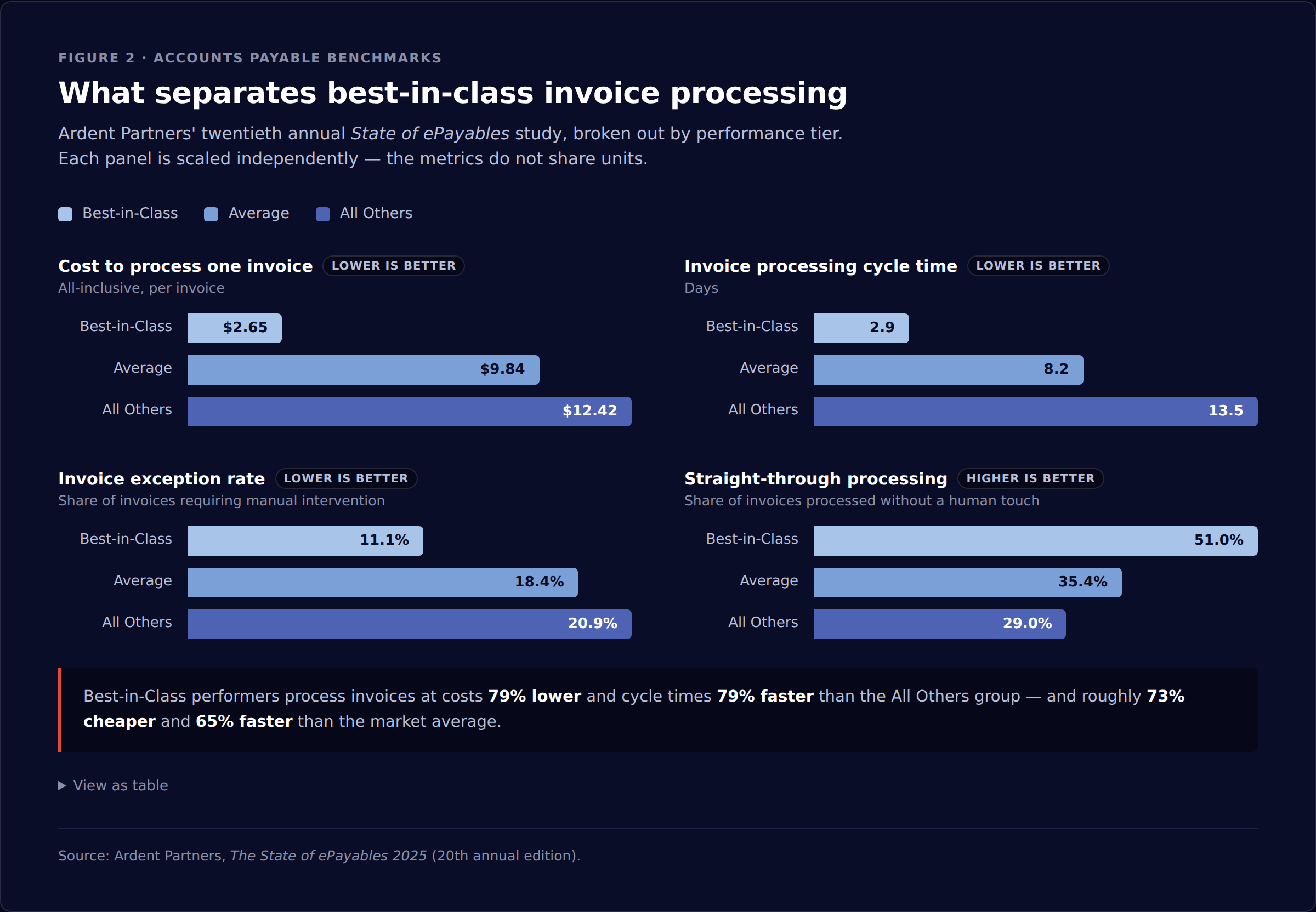
Ardent Partners’ State of ePayables 2025 — the twentieth annual edition of the study — reports the following across surveyed accounts payable organizations:
| Metric | Best-in-Class | Average | All Others |
|---|---|---|---|
| All-inclusive cost to process one invoice | $2.65 | $9.84 | $12.42 |
| Invoice processing cycle time | 2.9 days | 8.2 days | 13.5 days |
| Invoice exception rate | 11.1% | 18.4% | 20.9% |
| Straight-through processing rate (higher is better) | 51.0% | 35.4% | 29.0% |
(Ardent Partners, The State of ePayables 2025)
Best-in-Class performers process invoices at costs 79% lower and cycle times 79% faster than the All Others group — and roughly 73% cheaper and 65% faster than the market average. Note that straight-through processing runs the opposite direction from the other three metrics: there, more is better.
A different and broader measure points the same way. APQC’s Open Standards Benchmarking puts the median cycle time from invoice receipt to payment transmitted at 15.0 days across 2,226 organizations — a longer span than Ardent measures, which is why the two numbers differ. (APQC)
The Hackett Group adds the productivity link: organizations achieving 30% or higher touchless invoice processing have, on average, 3.5 times higher AP productivity, and solutions evaluated in its 2025 Digital World Class Matrix showed average AP cycle times improving 59% post-implementation. (The Hackett Group, 19 Nov 2025)
Flexera’s 2026 State of the Cloud Report found estimated wasted cloud spend at 29%, reversing a five-year downward trend (Flexera), and its 2026 State of ITAM Report found only 31% of organizations have accurate visibility into their AI software, with complete IT asset visibility down to 36% and 48% of respondents audited in the past year (Flexera). Zylo’s 2026 SaaS Management Index, built on more than 40 million licenses and $75 billion in spend under management, puts average annual waste on unused licenses at $19.8 million per organization (Zylo Index; figure cited here).
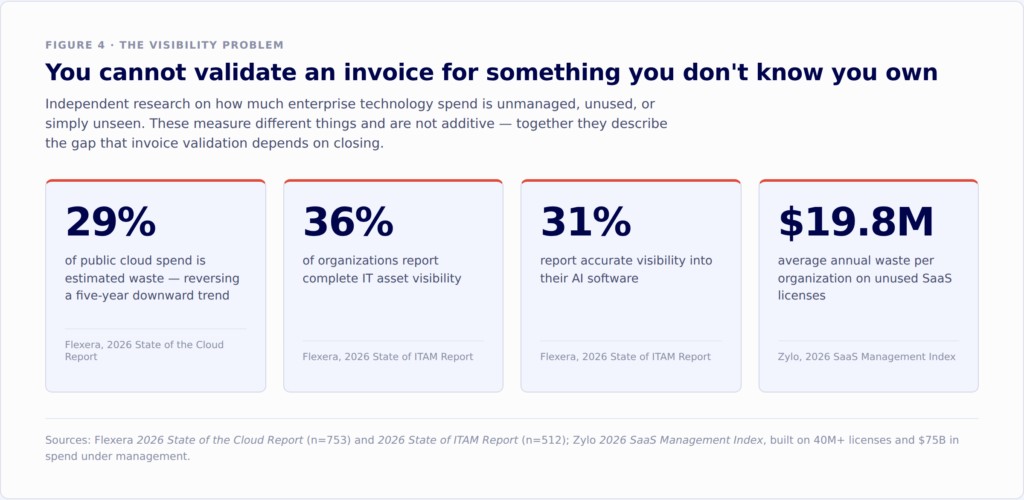
You cannot validate an invoice for something you do not know you own. That is the argument for pairing invoice validation with automated asset discovery into a single inventory, which is precisely what Asignet’s integrated Cloud/ITAM discovery does: Collect inventory, financial, and contractual data into a central CMDB.
The fraud dimension
Validation is a control, not simply a cost lever. The Association for Financial Professionals found that 76% of U.S. organizations experienced attempted or actual payments fraud in 2025, with 74% affected by business email compromise, while just 17% use AI to combat it. (AFP, 2026 Payments Fraud and Control Survey) A bot that checks every invoice against a contract and a purchase order before payment is a fraud control that never gets tired at month-end.
What automated invoice validation involves, end to end
Retrieve. Bots log into carrier, SaaS, cloud, and vendor portals and collect invoices. This includes the vendors who will never send you a structured file.
Parse. The parser automation tool maps any invoice format, in any layout, without hand-coded templates per vendor. This is the step that usually gates scale: if adding a vendor requires a developer, you will never onboard the long tail.
Validate. Every line is checked against contracted rates, purchase orders, budgets, and the asset inventory. Rate errors, charges for disconnected services, unrecognized line items, duplicates, and quantity mismatches surface before payment, not after.
Adjudicate. Clean invoices flow straight through. Exceptions route to people with authority to judge them (i.e. the hybrid model discussed earlier).
Dispute and recover. Managed services pursue credits and vendor negotiations on your behalf.
Optimize. Continuous tuning as contracts, vendors, and inventory change.
How to evaluate an RPA vendor
Sales teams love demos because they can control all of the variables, and there are usually no surprises. Here are some questions to ask that will separate good demos from successful deployments:
On maintenance. When a vendor portal changes its layout, what happens? Who fixes it, how fast, and at whose cost?
On the “no code” claim. Ask what percentage of a typical production automation ends up as custom script. Compare it to the 11.4% that Forrester’s leaders achieved.
On measurement. Will they baseline your current cycle time, error rate, and cost per transaction before go-live, and re-measure after? If savings are self-estimated, refer them to the GSA audit.
On adjudication. What happens to an exception? A platform that only handles clean cases has automated the easy third and left you the expensive two-thirds.
On agent washing. If AI or agentic capability is claimed, ask specifically which decisions the model makes autonomously and which are rule-governed? How are they logged?
On lock-in. Who owns the automations you build? Can your team maintain them without the vendor?
A realistic first 90 days
Days 1–30 — Establish the baseline. Pick one process. Measure its current cost, cycle time, and error rate before touching anything. Document the rules exhaustively, including the exceptions people handle by instinct. Identify the owner. Asignet scopes a proof of concept in this window.
Days 31–60 — Build and test against reality. Configure the automation, then test it against the ugly cases: malformed documents, changed templates, timeouts, out-of-order events. Define the exception path and who’s responsible for it.
Days 61–90 — Deploy narrow, measure honestly, then widen. Run in production on a limited scope with monitoring in place. Re-measure against the day-one baseline. Only after the numbers hold should scope expand to new processes, should be chosen with the same scorecard as the first.
Frequently asked questions about RPA
Is RPA the same as AI? No. Classical RPA follows explicit rules and does not learn. Modern deployments combine deterministic RPA for execution with AI for reading unstructured documents and handling exceptions, but the two are architecturally distinct.
Will AI agents make RPA obsolete? Not on the evidence available. Forrester predicts fewer than 15% of firms will turn on agentic features in intelligent automation suites during 2026, and Gartner expects over 40% of agentic AI projects to be canceled by the end of 2027. AI tends to be a black box. Rules-based automation remains the default where decisions must be explainable.
How long until RPA pays for itself? Deloitte found the average payback period for organizations piloting intelligent automation lengthening from 16 months in 2020 to 22 months in 2021/22. A single well-chosen high-volume process can pay back considerably faster; a poorly scoped program may never pay back at all.
Do I need developers? Forrester found 79% of RPA programs required advanced programming skills and that bot logic averaged 42% custom script — but leaders held that to 11.4%. Low-code platforms materially reduce the dependency; they do not eliminate the need for governance.
What should I automate first? Something high-volume, rules-based, stable, digital, and consequential when wrong. Invoice validation fits four of the five outright. Source-system stability is the exception (vendor and carrier portals change without warning) which is why maintenance capacity, not build capacity, is the real constraint on portal-based automation.
How do I know the savings are real? Baseline before you build, and re-measure after. The GSA Inspector General found a federal agency’s 240,000-hour savings claim unreliable because it was estimated rather than verified with end users.
Where to go next
If you have read this far, the useful next step is running the numbers against your own invoices, rather than an industry average.
Request a free ROI analysis of your invoice validation.
Related reading:
What is hyperautomation? · Unified Communications Management: How RPA Will Evolve · The Complete Guide to TEM
Related solutions:
Telecom Expense Management · Mobile Expense Management · Smarter Automation · Technology Lifecycle · SaaS Management · Cloud Expense Management
References
- DeMott, D. L. (SAIC). Human Reliability and the Cost of Doing Business, 2014. Reliability & Maintainability Symposium paper archived on the NASA Technical Reports Server. https://ntrs.nasa.gov/citations/20140008715
- Deloitte. Automation with intelligence: Reimagining the organization in the ‘Age of With’ (2019 global intelligent automation survey). https://www.deloitte.com/content/dam/assets-shared/legacy/docs/insights/2022/DI_DR26-Automation-with-intelligence.pdf
- Deloitte Insights. Automation with intelligence: 2022 intelligent automation survey results, 30 June 2022. https://www.deloitte.com/us/en/insights/topics/talent/intelligent-automation-2022-survey-results.html
- Forrester Consulting (commissioned by Tricentis). RPA Reality Check, 12 Feb 2020. https://www.businesswire.com/news/home/20200212005226/en/RPA-Reality-Check-New-Forrester-Research-Identifies-Barriers-to-RPA-Scalability
- U.S. GSA Office of Inspector General. GSA’s Robotic Process Automation Program Lacks Evidence to Support Claimed Savings, Report A210057/B/5/F24001, 30 Nov 2023. https://www.gsaig.gov/content/gsas-robotic-process-automation-program-lacks-evidence-support-claimed-savings
- EY. Get ready for robots: Why planning makes the difference between success and disappointment, 2016. https://eyfs.ie/wp-content/uploads/2016/11/ey-get-ready-for-robots.pdf
- Gartner. Gartner Predicts Over 40% of Agentic AI Projects Will Be Canceled by End of 2027, 25 June 2025. https://www.gartner.com/en/newsroom/press-releases/2025-06-25-gartner-predicts-over-40-percent-of-agentic-ai-projects-will-be-canceled-by-end-of-2027
- Forrester. Predictions 2026: Automation At The Crossroads (blog summary of the report Predictions 2026: Automation And Robotics, RES184998). https://www.forrester.com/blogs/predictions-2026-automation-at-the-crossroads/
- Forrester. The State Of Agentic AI In 2026, 3 June 2026. https://www.forrester.com/blogs/the-state-of-agentic-ai-in-2026-companies-are-chasing-few-are-catching/
- Gartner. Autonomous Business and AI Layoffs May Create Budget Room but Do Not Deliver Returns, 5 May 2026. https://www.gartner.com/en/newsroom/press-releases/2026-05-05-gartner-says-autonomous-business-and-artificial-intelligence-layoffs-may-create-budget-room-but-do-not-deliver-returns
- Ardent Partners. The State of ePayables 2025 — AP benchmarks and Best-in-Class performance. https://payablesplace.ardentpartners.com/2026/01/state-of-epayables-part-nine-ap-benchmarks-and-best-in-class-performance/
- APQC Open Standards Benchmarking. Cycle time in days from receipt of invoice until payment is transmitted. https://www.apqc.org/resources/benchmarking/open-standards-benchmarking/measures/cycle-time-days-receipt-invoice-until
- The Hackett Group. Hackett Identifies AP Solutions Delivering Gains Through AI, 19 Nov 2025. https://www.thehackettgroup.com/hackett-identifies-ap-solutions-delivering-gains-through-ai/
- Flexera. 2026 State of the Cloud Report, 18 March 2026. https://www.flexera.com/about-us/press-center/flexera-finds-cloud-value-is-rising-while-ai-waste-grows
- Flexera. 2026 State of ITAM Report, 24 June 2026. https://www.flexera.com/about-us/press-center/flexera-2026-state-of-itam-report-reveals-only-31-percent-organizations-have-visibility-into-ai-as-spend-surges
- Zylo. 2026 SaaS Management Index, 29 Jan 2026. https://zylo.com/news/2026-saas-management-index — $19.8M unused-license waste figure cited at https://zylo.com/blog/how-much-wasted-on-saas-spend
- Association for Financial Professionals. 2026 AFP Payments Fraud and Control Survey Report, 14 April 2026. https://www.financialprofessionals.org/about/learn-more/press-releases/Details/over-75-percent-of-us-firms-experienced-payments-fraud-in-2025-while-ai-adoption-for-fraud-mitigation-lags
- Forbes Technology Council. 14 Benefits Of Low-Code App Development That Tech Pros Love, 24 March 2020. https://www.forbes.com/sites/forbestechcouncil/2020/03/24/14-benefits-of-low-code-app-development-that-tech-pros-love/
- Crown Commercial Service. The Cost of Doing Nothing: A guide to tracking and controlling your telecom and IT estates to reduce costs and improve business intelligence, July 2019 (ref 5081-19). https://assets.crowncommercial.gov.uk/wp-content/uploads/RM3820-Telecoms-audit-white-paper-v.01.pdf