Introduction
Not long ago, predicting how much your company would spend on technology was relatively simple.
You knew how many employees needed a license, how much each subscription cost, and what your monthly or annual bill would look like.
Then AI entered the picture.
Today, almost every department is finding ways to integrate AI into its daily operations. Marketing teams use it to create content, developers use it to write code, customer service teams automate responses, and finance teams use it to process information.
And while AI is helping enterprises become more productive, it’s also introducing a new challenge: How do you control spending when costs depend on consumption?
Unlike traditional software subscriptions, many AI tools charge based on tokens, API calls, or the amount of computing resources consumed. The more employees use them, the more companies can end up paying.
But it’s not just about how frequently AI is used. It’s also about how efficiently.
An employee who doesn’t know how to write an effective prompt might need several attempts to complete a task that could have been solved in one. An AI agent might execute multiple requests in the background without anyone realizing how much it’s consuming.
Multiply that by hundreds or thousands of employees, and small inefficiencies can turn into significant expenses.
The problem isn’t that enterprises are adopting AI. It’s that the way they manage technology spending hasn’t caught up with the way AI is consumed.
And that needs to change.
01. The AI Bill Nobody Expected
For years, enterprises have been used to paying for technology based on relatively predictable pricing models.
A fixed monthly subscription. A software license per employee. An annual contract with an agreed price.
Of course, not every technology expense was fixed. Cloud infrastructure and telecom services have been consumption-based for years. But for many business applications, budgeting was still built around knowing how much access would cost.
AI is changing that.
Instead of simply paying for access to a tool, companies are increasingly paying for how much they use it. And that consumption can vary dramatically depending on the task, the model being used, and the way employees interact with it.
To understand how quickly this can become a problem, consider what happened at a major global technology company.
According to a 2026 Financial Times investigation referenced in Asignet’s Spend Integrity research, the company introduced a monthly AI spending allowance of $1,500 per employee. Yet employees had already exceeded their expected consumption by April.
The company had established a spending limit. What it couldn’t fully predict was how quickly employees would consume it.
And this isn’t an isolated challenge.
The FinOps Foundation’s 2026 research, cited in the same report, found that 98% of surveyed FinOps teams were managing AI spending, compared with just 31% in 2024.
AI cost management has quickly become part of the financial conversation.
And as AI adoption continues growing, enterprises need more than a budget set at the beginning of the year. They need to understand what’s happening with that budget while it’s being consumed.
02. Where Is All That AI Spending Going?
Imagine asking two employees to complete the same task using AI.
One writes a clear prompt, provides the right context, and gets the answer in one or two attempts.
The other starts with a vague instruction, gets an incomplete response, asks the AI to try again, adds more context, and repeats the process several times.
Both employees completed the same task.
But depending on the tools, models, and pricing involved, the cost of getting there could be very different.
Now imagine that happening across an enterprise with thousands of employees.
And inefficient prompting is only one part of the problem.
AI consumption can increase for several reasons:
- Unnecessary token usage: Long conversations, repeated prompts, and excessive context can consume more tokens than a task requires.
- Model selection: Employees may use more expensive AI models for tasks that could be completed with less costly alternatives.
- AI agents: Automated workflows can trigger multiple requests, repeat tasks, and consume resources without constant human interaction.
- Fragmented tools: Different departments may use different AI providers, making it difficult to understand total consumption.
- Lack of visibility: Companies may receive a bill without clearly understanding which team, application, or project generated the expense.
There’s also another problem: not every AI expense translates into business value.
A department could be spending thousands of dollars on AI tools without knowing whether that investment is actually improving productivity or reducing operational costs.
And that’s where the conversation needs to go beyond how many tokens were consumed.
It’s not just about how much AI costs. It’s about understanding what you’re getting in return.
03. AI Is Forcing Enterprises to Rethink Budget Ownership
Traditionally, enterprise technology spending has been managed centrally.
Finance establishes budgets, IT manages technology resources, and procurement negotiates contracts with suppliers.
But what happens when employees across every department are making daily decisions that directly affect how much the company spends?
Think about it.
A marketing team decides which AI tools to use for content creation. A development team chooses which models to integrate into its applications. A customer service team increases the number of automated interactions it handles.
Each decision can influence the company’s AI expenses.
Yet the people making those decisions don’t always know how much they’re spending.
And if they don’t know, how are they supposed to control it?
Every team should understand the cost of the AI it consumes.
This doesn’t mean Finance should stop managing enterprise budgets.
It means financial responsibility needs to be shared with the departments generating the expenses.
For example, imagine a company allocating an AI consumption budget to each department.
Marketing has a budget for its AI tools. Development has another. Customer service has its own.
Each team can see how much it has consumed, how much budget remains, and which tools or activities are generating the highest costs.
Finance still has visibility over the entire organization, but department managers now have the information they need to make better decisions.
This approach is known as showback: making costs visible to the teams responsible for generating them, without necessarily charging those expenses directly to departmental accounts.
And it changes the way people think about consumption.
When a team can see that a particular workflow is consuming more resources than expected, it has a reason to investigate why.
Maybe employees need better prompting guidelines. Maybe a different AI model would deliver the same result at a lower cost. Or maybe a tool is being used for tasks that don’t justify the expense.
The point isn’t to make employees afraid of using AI.
It’s to give them the information they need to use it responsibly.
Because the teams consuming AI should also understand the financial impact of their decisions.
04. You Can’t Control What You Can’t Connect
Let’s say your company works with several AI providers.
One department uses OpenAI. Another uses Anthropic. Your development team consumes AI through cloud infrastructure, while other employees use AI features included in existing SaaS platforms.
Each provider has its own pricing model, billing structure, and consumption metrics.
Some charge per token. Others use credits, API requests, subscriptions, or combinations of these models.
So how do you compare them?
And more importantly, how do you know whether you’re being charged correctly?
This is where traditional expense management becomes more complicated.
Knowing how much a supplier charged isn’t enough.
Enterprises need to connect four pieces of information:
- What was agreed: Contracts, pricing terms, rates, and spending commitments.
- What was consumed: Tokens, API calls, model usage, and other consumption records.
- What was billed: Provider invoices and billing statements.
- What was paid: The actual payments, adjustments, and credits.
These records should tell the same financial story.
But when the information lives in different systems, discrepancies can go unnoticed.
A company may be billed at a rate that doesn’t match its agreement. A provider’s usage records may not match internal consumption data. Or a department may exceed its expected budget without anyone noticing until the invoice arrives.
And by then, the money has already been spent.
This challenge isn’t completely new.
Enterprises have dealt with similar problems in telecom, cloud, and software expense management for years.
What makes AI different is the speed and variability of consumption.
The faster spending happens, the faster financial controls need to respond.
05. How Asignet Helps Enterprises Take Control of AI Spending
Managing AI expenses shouldn’t mean manually reviewing usage reports from every provider, comparing spreadsheets, and trying to identify which department generated each charge.
Especially when consumption can change every day.
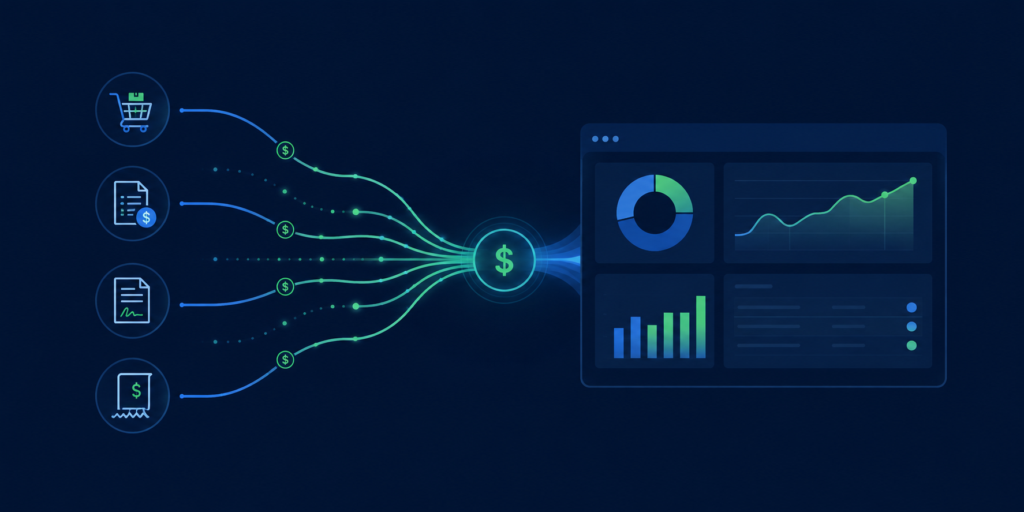
At Asignet, we bring AI usage, supplier economics, and financial accountability together in one connected view.
Our approach to Token Expense Management is built around five steps.
Connect: Bring AI spending into one place
The first challenge is fragmentation.
AI usage data, billing information, and supplier costs can be spread across multiple providers, agents, cloud platforms, and applications.
Asignet connects these sources to provide a consolidated view of AI consumption.
Instead of looking at each provider separately, enterprises can begin to understand how much they’re spending across their AI ecosystem.
Normalize: Make different consumption models comparable
Not every AI provider measures consumption the same way.
Some use tokens, others use credits, and others combine subscriptions with usage-based charges.
Asignet normalizes these different consumption and pricing models into a consistent financial view.
This allows companies to compare costs across providers and understand how different tools contribute to total spending.
Allocate: Know who’s responsible for each expense
Knowing that your company spent a certain amount on AI is useful.
Knowing which department, project, application, or user generated that expense is much more valuable.
Asignet helps allocate AI costs to the business units responsible for consumption.
This makes departmental showback possible and gives teams visibility into their own spending.
Finance maintains oversight, while individual departments can understand their consumption and take greater responsibility for managing it.
Govern: Identify problems before they become bigger expenses
What happens when an AI workflow suddenly starts consuming more tokens than expected?
Or when a department is approaching its allocated budget halfway through the month?
Without ongoing monitoring, these situations might only become visible after the invoice arrives.
Asignet supports budget tracking, spending forecasts, anomaly detection, and consumption thresholds.
This helps enterprises identify unexpected changes, investigate inefficient usage, and find opportunities to optimize spending.
The idea isn’t to limit innovation.
It’s to prevent unnecessary consumption from going unnoticed.
Reconcile + Prove: Connect AI spending to financial results
At the end of the day, understanding consumption is only part of the job.
Enterprises also need to know whether supplier charges match agreed terms and actual usage.
Asignet connects usage data with supplier contracts and billing information to support invoice validation and reconciliation.
It also helps organizations connect AI costs to utilization and business outcomes.
Because spending less isn’t always the goal.
Sometimes spending more on AI makes sense if it’s helping a department deliver better results, automate more processes, or improve productivity.
The important thing is being able to understand and justify that investment.
06. The Goal Isn’t to Use Less AI. It’s to Use It Better.
AI adoption isn’t slowing down.
More employees are using AI tools, more applications are integrating AI capabilities, and more companies are investing in automated workflows and agents.
Trying to stop that growth isn’t the answer.
But allowing AI consumption to increase without understanding where the money is going isn’t sustainable either.
Enterprises need to rethink how they approach technology spending.
They need to move from fixed-budget assumptions to consumption-based financial management.
From centralized oversight alone to shared accountability.
From reviewing invoices after expenses occur to monitoring usage and identifying problems earlier.
And from simply knowing how much AI costs to understanding whether that investment is delivering value.
This is what Token Expense Management makes possible.
AI is changing how enterprises work. Now it’s time to change how they manage what they spend.
At Asignet, we help enterprises bring visibility, accountability, and financial control to their AI consumption.