

Every dollar a company spends will touch a process, a policy, and usually a person who has to chase it down. Business spend management (BSM) is the discipline of making that entire chain visible, from sourcing -> buying -> paying -> and analyzing, instead of scattered across departments, spreadsheets, and disconnected tools.
This guide covers what BSM includes, why it’s become urgent for CFOs and CPOs right now, and what to look for when you’re evaluating a solution.
What Is Business Spend Management?
BSM is often used loosely, so it helps to separate it from two terms it gets confused with:
| Term | What each area covers |
|---|---|
| Business Expense management | Employee-incurred costs — travel, meals, mileage, card purchases — and the reimbursement workflow around them |
| Spend analysis | A backward-looking exercise: categorizing historical spend data to find patterns |
| Business spend management | The full lifecycle — sourcing, purchasing, contracting, invoicing, paying, and analyzing — across all categories of spend, direct and indirect, for the entire organization |
True BSM includes categories that never touch an employee expense report at all: telecom and IT services, SaaS subscriptions, cloud infrastructure, third-party vendor contracts, and recurring service agreements. This type of spend is often the largest and most opaque line on the P&L.
Why BSM Has Become a Board-Level Priority
A few forces have pushed spend visibility from a back-office concern to an executive one:
- Spend has decentralized. SaaS, cloud, and telecom purchases increasingly happen department-by-department, often outside procurement’s line of sight entirely.
- Vendor contracts have gotten more complex. Multi-carrier telecom agreements, tiered cloud pricing, and usage-based SaaS billing make it genuinely hard to know if an invoice matches what was actually agreed to.
- Margin pressure rewards precision. When budgets tighten, the easiest savings often aren’t new vendor negotiations — they’re stopping money that’s already leaking out through billing errors, duplicate charges, and unused licenses.
- Finance leaders are expected to have real-time answers, not quarterly ones, about where spend stands against budget.
The Building Blocks of BSM
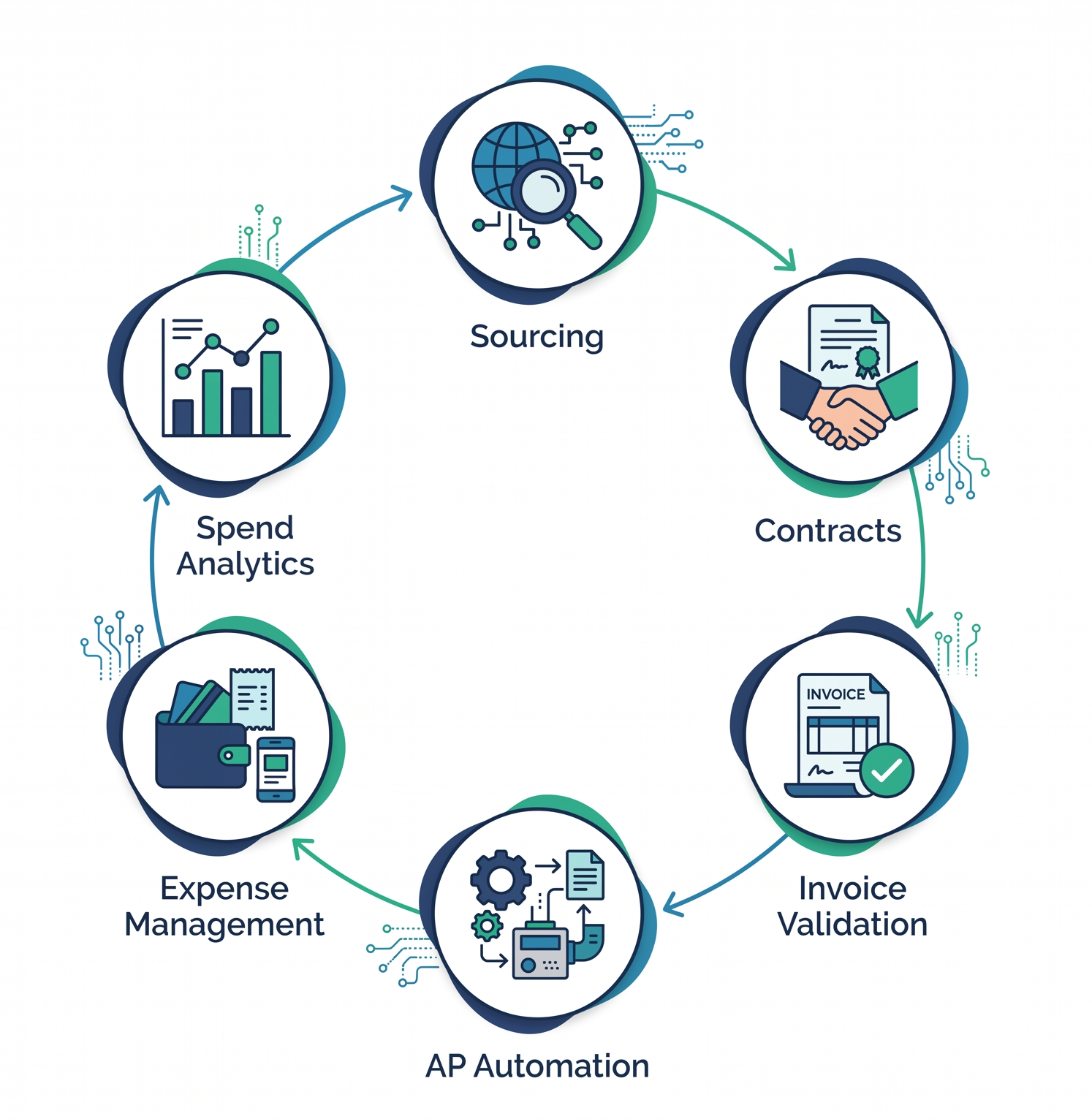
Most BSM programs are built from six connected functions. Weakness in any one of them creates blind spots in the rest:
- Sourcing and procurement — selecting vendors and negotiating terms
- Contract management — tracking obligations, renewal dates, and negotiated rates
- Invoice processing and validation — matching what’s billed against what was actually contracted and delivered
- Accounts payable automation — routing, approving, and paying invoices efficiently
- Expense management — employee-driven purchases and reimbursements
- Spend analytics — turning transaction data into decisions
Software vendors tend to specialize. Some are strong on sourcing and procurement workflows; others focus on employee expense capture. Fewer are built around the third function on that list — invoice validation — which is where a surprising amount of avoidable spend hides.
The Hidden Problem: Spend Leakage
Implementing procurement software or an AP workflow tool doesn’t guarantee you’re paying the right amount. It just guarantees you’re paying faster and with more approvals.
Spend leakage happens when:
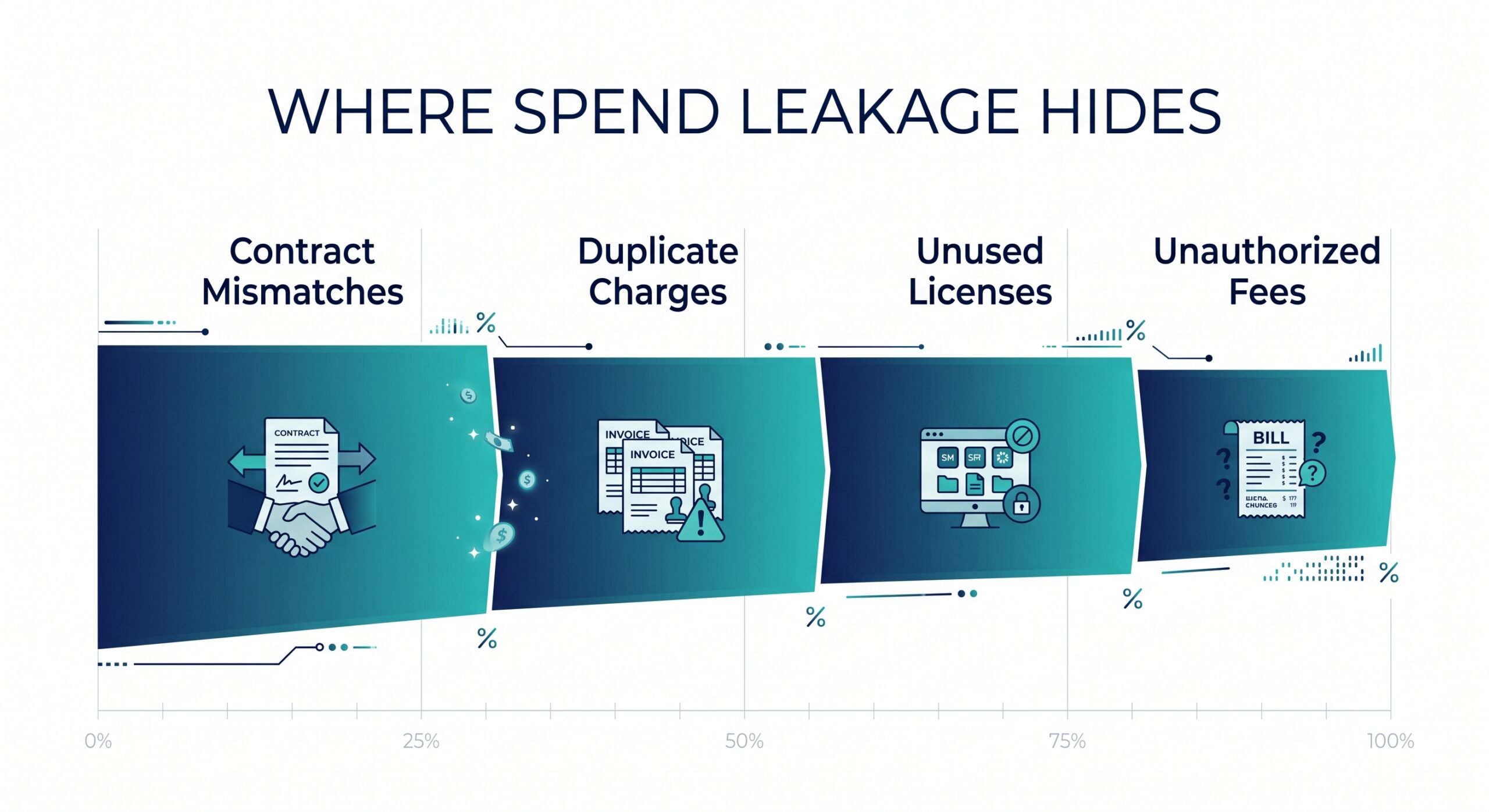
- A vendor bills at a rate that doesn’t match the negotiated contract
- Duplicate or overlapping charges slip through on high-volume invoices (common in telecom and multi-carrier billing)
- SaaS licenses continue being paid for after employees leave or teams stop using the tool
- Usage-based cloud or service charges include fees never actually agreed to
None of this shows up as a “process problem”. The invoice gets approved and paid on time, every time. It shows up months later as unexplained cost creep that nobody can trace back to a root cause, because nobody was checking the invoice against the contract line by line.
This is the layer Asignet’s business spend management solution is built around: automated, ongoing invoice validation against contracted terms. It’s a meaningfully different problem than the one most general-purpose procurement or AP platforms are solving for.
How BSM Maturity Progresses
Organizations tend to move through recognizable stages:
| Stage | What it looks like |
|---|---|
| Manual | Spreadsheets, email approvals, invoices checked (if at all) by whoever has time |
| Automated workflow | Purchase orders, approvals, and payments run through software — but validation is still spot-checked or skipped |
| Unified visibility | Spend data across categories lives in one place; finance can see total spend by vendor, department, and category |
| Continuous validation | Every invoice is automatically checked against contract terms and usage data before it’s paid |
| Predictive optimization | Spend patterns inform sourcing and renewal decisions before contracts even come up for renewal |
Most organizations plateau at “unified visibility”. They can see spend clearly, but nothing is actively checking whether what they’re being billed is correct. Getting to continuous validation is where the real, durable savings tend to show up, because it catches the leakage that visibility alone never surfaces.
What to Look For in a Business Spend Management Solution
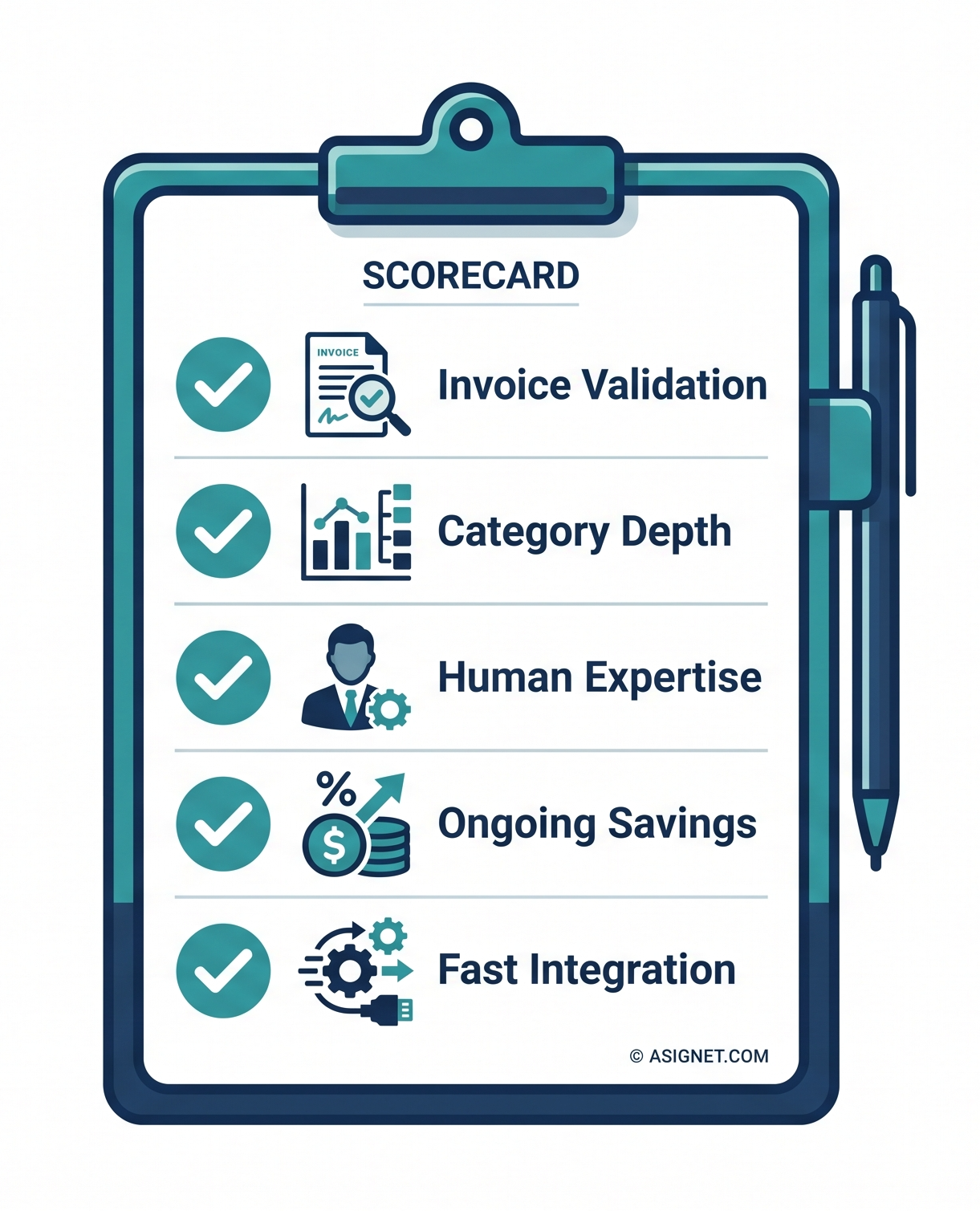
Does it validate invoices, or just route them?
Ask a vendor to show you how their system catches a billing discrepancy against a contract, not just how quickly it can approve an invoice.
Does it cover the categories that are actually hard to track?
Employee expense capture is a solved problem industry-wide. The harder test is telecom, mobile, SaaS, and cloud spend, where billing is usage-based, multi-vendor, and genuinely difficult to reconcile by hand.
Is the automation backed by people who understand the category?
Software alone often can’t interpret an unusual telecom carrier invoice format or a nonstandard SaaS contract clause. The strongest programs combine automation with analysts who know how to read the fine print. This is part of why Asignet pairs its platform with professional services, rather than shipping software alone.
Can it show ongoing savings, not just a one-time cleanup?
Find a system that keeps finding them every billing cycle.
Does it integrate without a multi-quarter implementation?
Look for BSM solutions that can connect to existing ERP, AP, and procurement systems without requiring you to rip and replace what already works.
Is there a track record in your specific spend category?
A platform built broadly for “all spend” is not automatically strong in telecom, cloud, or SaaS specifically. Most categories will have their own billing quirks and contract structures. Ask for examples in your category.
Getting Started Without Overhauling Everything at Once
BSM doesn’t have to mean a company-wide platform replacement in year one. A practical sequence could look like this:
- Start with your least-visible spend category. For most companies, that’s telecom, mobile, SaaS, or cloud.
- Run a validation pass before automating everything else. Understanding how much of your current spend is already correct tells you where the real savings are before you invest further.
- Fix what you find, then automate to keep it fixed. Manual cleanup catches today’s errors; automated, continuous validation prevents tomorrow’s.
- Expand category by category, rather than attempting one simultaneous rollout across procurement, AP, and expense management at once.
Asignet’s own telecom expense management, cloud expense management, mobile expense management, and SaaS management solutions were built around this category-first approach because those are the four areas where invoice complexity most often outpaces what internal teams can review manually.
The organizations getting the most value from BSM are the ones treating invoice-level validation as a continuous discipline, not a one-time project. They use it to catch the billing errors, duplicate charges, and contract mismatches that visibility dashboards alone don’t surface.
If you’re evaluating what that could look like for your organization, get in touch to schedule a walk through of Asignet’s business spend management solution. There’s no telling what a validation pass on your current spend might find.


